
5+ Medical Assistant Resume Examples & Writing Guide (2026) | Free Templates

Trust Score: 4.8
387 reviews
Table of Contents
Introduction
The demand for medical assistants is rapidly growing as the healthcare industry expands to meet the needs of an aging population and increased access to medical services. From hospitals and private clinics to diagnostic labs and outpatient care centers, skilled medical assistants play a vital role in ensuring smooth daily operations. This surge in demand means more job opportunities but also increased competition among candidates aiming to secure the best positions.
In such a competitive hiring landscape, having a strong, well-structured resume is no longer optional it’s essential. Recruiters often spend just a few seconds scanning each application, and many healthcare organizations use Applicant Tracking Systems (ATS) to filter resumes before they even reach human eyes. A professionally crafted medical assistant resume that highlights your clinical expertise, administrative skills, and relevant certifications can significantly improve your chances of landing interviews.
In this guide, you’ll learn exactly how to create a job-winning medical assistant resume. We’ll walk you through the ideal structure, essential skills, real resume examples, and expert tips to optimize your resume for ATS. Whether you're an entry-level candidate or an experienced professional, this guide will help you build a resume that stands out and gets results.
What Does a Medical Assistant Do?
Medical assistants are essential healthcare professionals who support both clinical and administrative operations in medical settings. Their role is dynamic, requiring a balance of patient care skills and organizational efficiency. Depending on the workplace, their responsibilities may vary, but they typically cover the following areas:
Clinical Responsibilities for a Medical Assistant
Medical assistants often work directly with patients and healthcare providers to ensure smooth clinical procedures. Their duties may include:
 Measuring and recording vital signs such as blood pressure, temperature, and pulse
- Assisting physicians during examinations and minor procedures
- Preparing patients for tests and explaining treatment procedures
- Collecting and processing lab samples (e.g., blood, urine)
- Administering medications or injections (depending on certification and regulations)
- Maintaining cleanliness and sterilization of medical instruments
These tasks require attention to detail, technical knowledge, and a strong commitment to patient care.
Administrative Duties for a Medical Assistant
In addition to clinical work, medical assistants handle a wide range of front-office responsibilities that keep healthcare facilities running efficiently:
- Scheduling patient appointments and managing calendars
- Maintaining and updating patient medical records (often using EHR systems)
- Handling billing, insurance claims, and coding
- Answering phone calls and responding to patient inquiries
- Coordinating communication between patients, doctors, and insurance providers
Strong organizational and communication skills are crucial for managing these tasks effectively.
Key Skills Employers Look for in a Medical Assistant
To stand out in a competitive job market, medical assistants need a combination of technical and soft skills. Some of the most in-demand skills include:
- Clinical Skills: Phlebotomy, EHR/EMR systems, patient care, vital signs monitoring
- Administrative Skills: Medical billing, scheduling, data entry, record management
- Soft Skills: Communication, empathy, teamwork, attention to detail
- Technical Skills: Knowledge of healthcare software, basic computer proficiency
- Time Management: Ability to multitask in fast-paced environments
Employers value candidates who can seamlessly handle both patient interaction and administrative responsibilities, making versatility one of the most important qualities for a successful medical assistant.
Medical Assistant Resume Examples
Below are tailored resume examples to help you understand how to structure your medical assistant resume based on your experience level and specialization.
Entry-Level Medical Assistant Resume
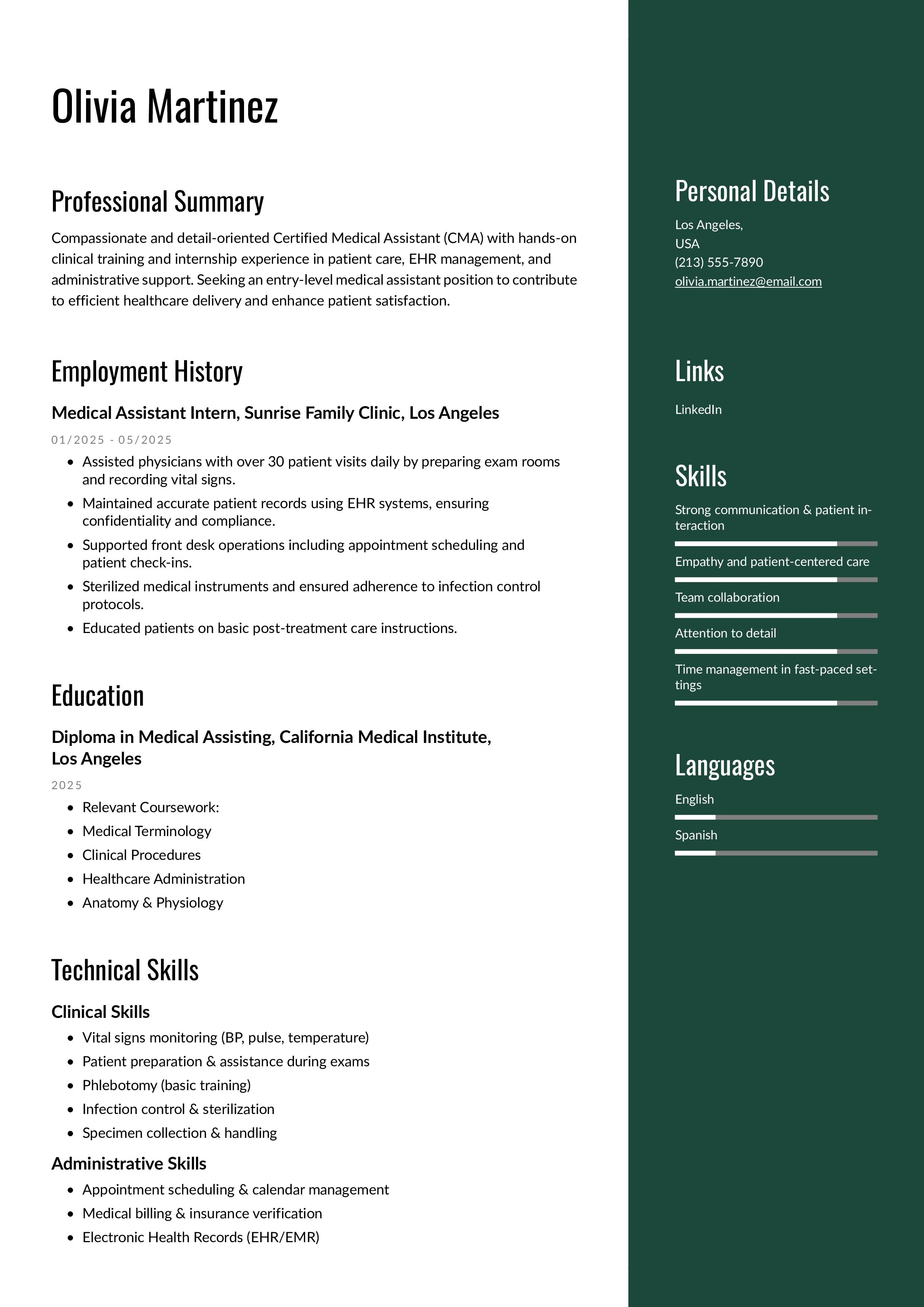
Why This Resume Works
1. Strong Entry-Level Positioning
Even without full-time experience, the resume highlights internships and clinical training, making the candidate job-ready.
Includes relevant keywords like patient care, EHR, phlebotomy, medical assistant, ensuring better visibility in Applicant Tracking Systems.
3. Clear Sectioning & Readability
Well-organized sections (Skills, Experience, Education, Certifications) make it easy for recruiters to scan within seconds.
Use of numbers like “30+ patient visits daily” adds credibility and demonstrates real-world exposure.
5. Balanced Skill Set
Showcases both clinical and administrative abilities, which is exactly what employers look for in medical assistants.
6. Certifications Highlighted Prominently
Important credentials like CMA and CPR are clearly listed, increasing trust and eligibility.
Experienced Medical Assistant Resume
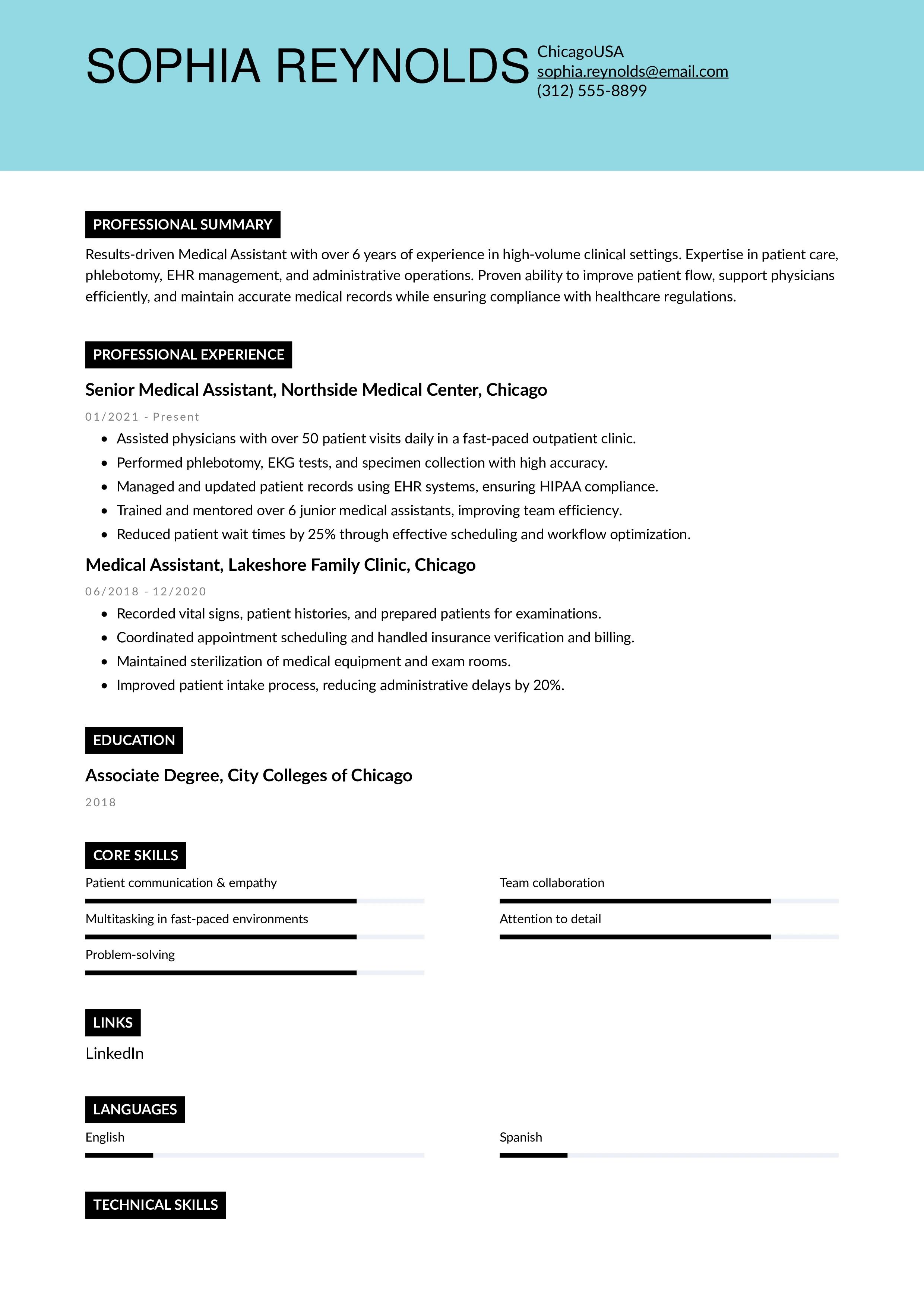
Why This Resume Works
1. Strong Professional Summary
Clearly highlights experience, key skills, and value, making an immediate impact on recruiters.
2. Quantified Achievements
Metrics like “50+ patients daily” and “25% reduced wait time” demonstrate real, measurable contributions.
3. Balanced Skill Presentation
Effectively combines clinical expertise, administrative knowledge, and soft skills, matching employer expectations.
4. Career Progression
Shows growth from Medical Assistant to Senior Medical Assistant, building credibility.
5. ATS Optimization
Includes industry-relevant keywords like phlebotomy, EHR, HIPAA, patient care, increasing visibility in hiring systems.
6. Clean & Professional Structure
Well-organized sections ensure easy readability and quick scanning by recruiters.
Clinical Medical Assistant Resume
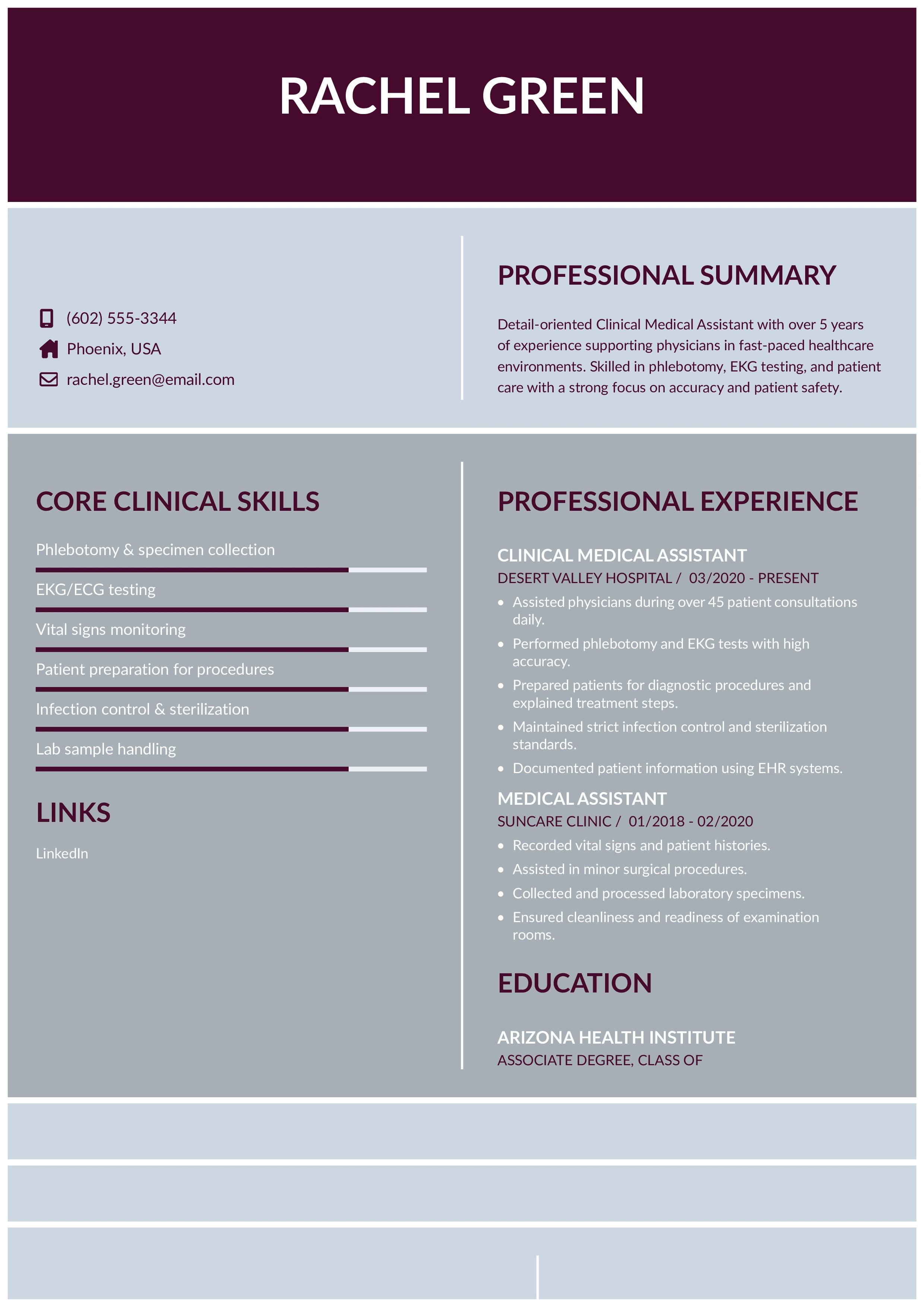
Why This Clinical Resume Works
1. Focuses Heavily on Hands-On Clinical Procedures
This resume clearly prioritizes real clinical experience, which is exactly what healthcare employers look for. Instead of being generic, it highlights specific tasks like phlebotomy, EKG testing, patient preparation, and specimen handling. These are practical, job-ready skills that show the candidate can step into a clinical environment with minimal training. Recruiters in hospitals and clinics prefer candidates who can immediately support physicians and patient care, and this resume communicates that effectively.
2. Uses Quantified Patient Volume to Show Experience
Including numbers such as “assisted with 45+ patient consultations daily” adds strong credibility. It shows that the candidate has worked in a fast-paced, high-pressure environment, which is common in healthcare settings. Quantifying experience helps employers understand workload capacity, efficiency, and real-world exposure—making the resume far more impactful than simply listing duties.
3. Includes Technical Healthcare Skills Recruiters Prioritize
The resume emphasizes in-demand clinical skills like phlebotomy, EHR systems, infection control, and diagnostic support. These are not just buzzwords—they are critical competencies that align directly with job descriptions. By including these keywords, the resume becomes:
- ATS-friendly, increasing chances of passing screening software
- Relevant to hiring managers, who quickly scan for these exact skills
This targeted approach ensures the resume speaks the same language as the employer.
Mid-Level Medical Assistant Resume
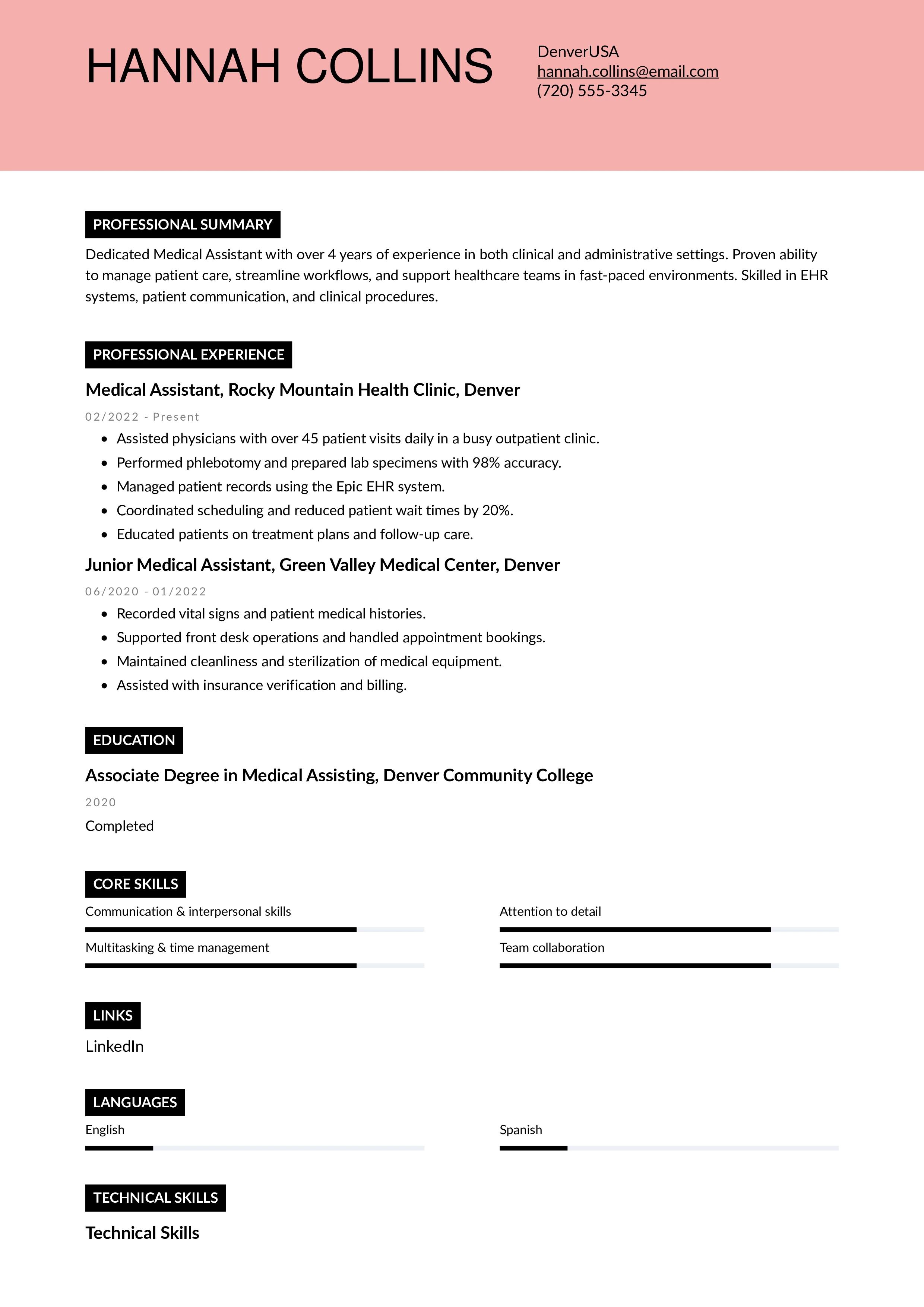
Why This Resume Works (Mid-Level Medical Assistant Resume)
1. Balanced Skill Representation
This resume effectively showcases both clinical and administrative skills, making the candidate versatile and suitable for a wide range of healthcare settings.
2. Strong Career Progression
It clearly demonstrates growth from a Junior Medical Assistant to a Medical Assistant role, which builds credibility and shows professional development.
3. Quantified Achievements
Metrics like “45+ patient visits daily” and “20% reduction in wait times” provide concrete proof of performance and efficiency.
4. ATS-Optimized Keywords
Includes important keywords such as EHR, phlebotomy, patient care, scheduling, ensuring better visibility in Applicant Tracking Systems.
Hospital-Focused Medical Assistant Resume Example
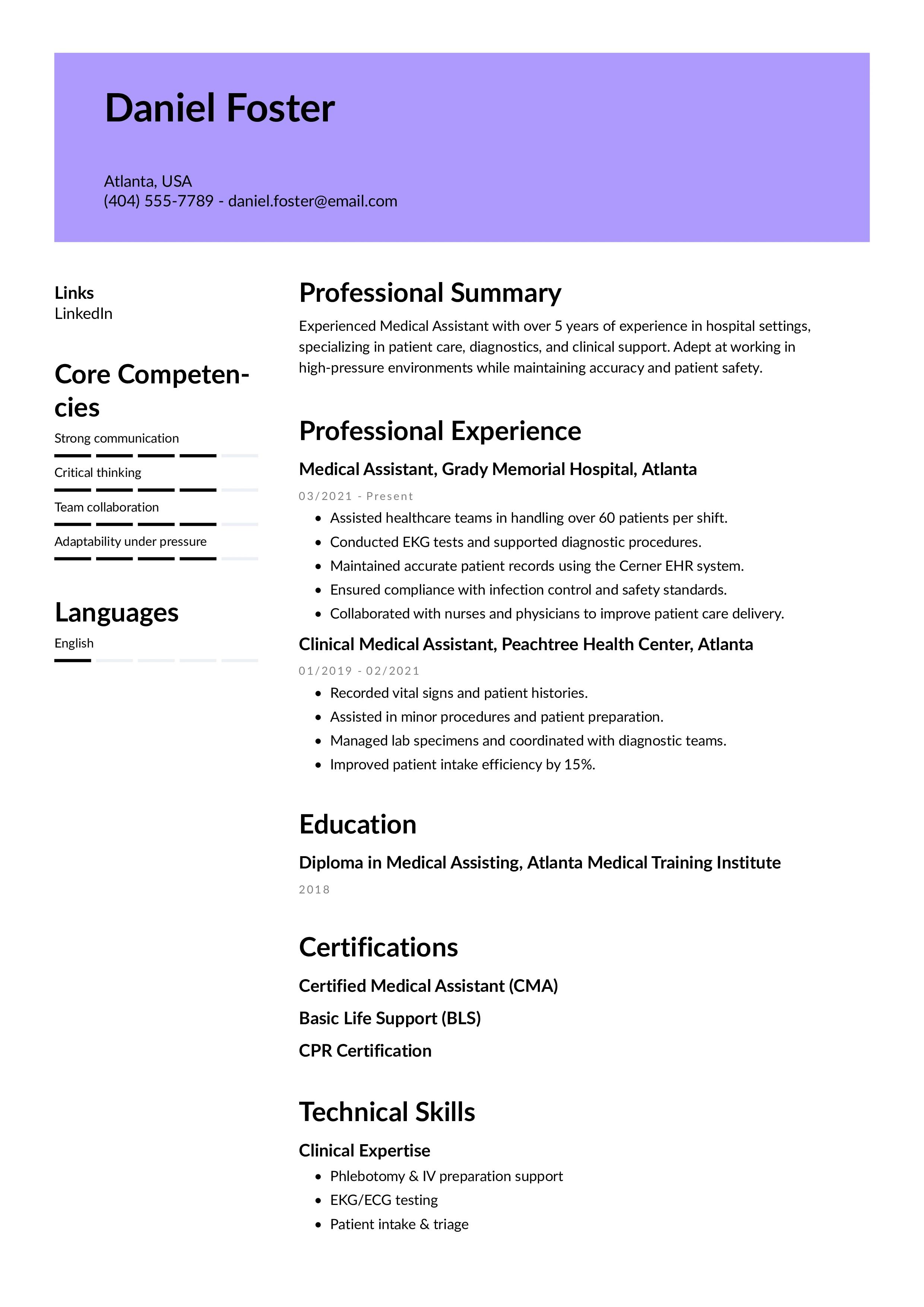
Why This Resume Works
1. Tailored for High-Pressure Environments
Specifically designed for hospital roles, highlighting the ability to handle 60+ patients per shift, which reflects real-world hospital demands.
2. Strong Clinical Focus
Emphasizes critical clinical skills like EKG testing, specimen handling, and infection control, aligning with hospital job requirements.
3. Team Collaboration Highlighted
Demonstrates experience working closely with nurses and physicians, which is essential in hospital settings.
4. Use of Industry Tools & Systems
Mentions tools like Cerner EHR, making the resume highly relevant and ATS-friendly.
5. Demonstrates Reliability & Adaptability
Shows ability to work under pressure, maintain accuracy, and adapt to dynamic healthcare environments qualities highly valued by employers.
How to Structure a Medical Assistant Resume
A well-structured medical assistant resume makes it easy for recruiters and ATS (Applicant Tracking Systems) to quickly identify your qualifications. The goal is to present your clinical expertise, administrative abilities, and certifications in a clear, organized format.
Here’s the ideal structure to follow:
1. Contact Information
Place this at the top of your resume.
Include:
- Full Name
- Phone Number
- Professional Email Address
- City & State
- (Optional) LinkedIn Profile
2. Resume Summary or Objective
This is a short 2–4 line introduction.
- Use a summary if you have experience
- Use an objective if you're entry-level
Example (Summary):
Example (Objective):
3. Skills Section
Highlight both clinical and administrative skills relevant to the role.
Include:
- Clinical: Vital signs, phlebotomy, EHR/EMR
- Administrative: Scheduling, billing, data entry
- Soft skills: Communication, empathy, teamwork
4. Work Experience
This is the most important section of your resume.
Format:
- Job Title
- Company Name
- Location
- Dates of Employment
Add bullet points:
- Start with action verbs (Assisted, Managed, Performed)
- Include measurable achievements
Example:
- Assisted in 40+ patient visits daily in a fast-paced clinic
- Recorded vital signs and maintained accurate patient records
- Improved scheduling efficiency by 20%
5. Education
List your most relevant educational qualifications.
Include:
- Degree/Diploma
- Institution Name
- Graduation Year
6. Certifications
Certifications are highly important for medical assistants.
Common ones:
- Certified Medical Assistant (CMA)
- Registered Medical Assistant (RMA)
- CPR & First Aid Certification
7. Optional Sections
Add these if relevant:
- Internships (for entry-level candidates)
- Volunteer Experience
- Languages (useful in healthcare settings)
- Professional Affiliations
Pro Tips for Perfect Structure
- Keep your resume 1 page (2 pages if highly experienced)
- Use a clean, ATS-friendly format (no graphics or tables)
- Stick to professional fonts and consistent formatting
- Tailor your resume for each job application
A well-structured medical assistant resume not only improves readability but also increases your chances of passing ATS filters and getting shortlisted for interviews.
How to Write a Medical Assistant Resume That Gets Interviews
Writing a Strong Resume Summary
Your resume summary is the first thing recruiters see, so it needs to make an immediate impact. In just a few lines, you should communicate your experience, key skills, and value as a medical assistant.
How to Craft a Compelling Summary
- Start with your job title and years of experience
- Highlight 2–3 key skills (clinical + administrative)
- Include a measurable achievement (if possible)
- Tailor it to the job description keywords
Examples
Experienced Medical Assistant:
Entry-Level Medical Assistant:
Medical Assistant Resume Skills (With Examples)
A strong skills section helps you pass ATS filters and quickly show employers your capabilities.
Clinical Skills
- Phlebotomy and specimen collection
- Vital signs monitoring
- EHR/EMR systems
- Patient care and preparation
- Infection control procedures
Administrative Skills
- Appointment scheduling
- Medical billing and coding
- Insurance verification
- Data entry and record management
- Front desk operations
Soft Skills
- Communication and interpersonal skills
- Empathy and patient-focused approach
- Teamwork and collaboration
- Attention to detail
- Time management and multitasking
Work Experience Section (With Examples)
This is the most critical part of your resume, where you prove your real-world impact.
How to Describe Responsibilities Effectively
- Focus on achievements, not just duties
- Use specific numbers to show impact
- Keep bullet points clear and concise
Use Action Verbs
Start each bullet point with strong verbs like:
- Assisted
- Managed
- Performed
- Coordinated
- Improved
Example Bullet Points
- Assisted physicians with 40+ patient consultations daily
- Performed phlebotomy and prepared lab specimens accurately
- Managed EHR records while ensuring HIPAA compliance
- Scheduled appointments and reduced patient wait time by 25%
- Trained and mentored new medical assistants
Education & Certifications
This section validates your qualifications and is especially important in healthcare roles.
Relevant Degrees and Diplomas
- Diploma in Medical Assisting
- Associate Degree in Medical Assisting
- Healthcare Administration (for admin-focused roles)
Important Certifications
- Certified Medical Assistant (CMA)
- Registered Medical Assistant (RMA)
- CPR & First Aid Certification
- Basic Life Support (BLS)
How to List Ongoing Education
If you’re currently studying, mention it like this:
Example:
Associate Degree in Medical Assisting (Expected 2026)
XYZ College
You can also include:
- Relevant coursework
- Clinical training hours
- Internships
A well-written summary, targeted skills section, and achievement-focused experience can significantly increase your chances of landing interviews in the healthcare field.
Create a Winning Medical Assistant Cover Letter with Instaresume’s AI Cover Letter Generator
Writing a compelling cover letter for a medical assistant role can be challenging especially when you need to balance clinical expertise, patient care, and administrative efficiency in just one page. That’s where Instaresume’s AI cover letter generator makes the process fast, easy, and highly effective.
Why Use an AI Cover Letter Generator for Medical Assistant Jobs?
A generic cover letter won’t stand out in today’s competitive healthcare job market. Instaresume helps you create a personalized, ATS-friendly cover letter tailored specifically to medical assistant roles.
Key Benefits:
- Generates job-specific content using medical assistant resume keywords
- Saves time with ready-to-edit professional templates
- Ensures proper structure and formatting
- Highlights both clinical and administrative strengths
- Optimized for Applicant Tracking Systems (ATS)
Medical Assistant Cover Letter
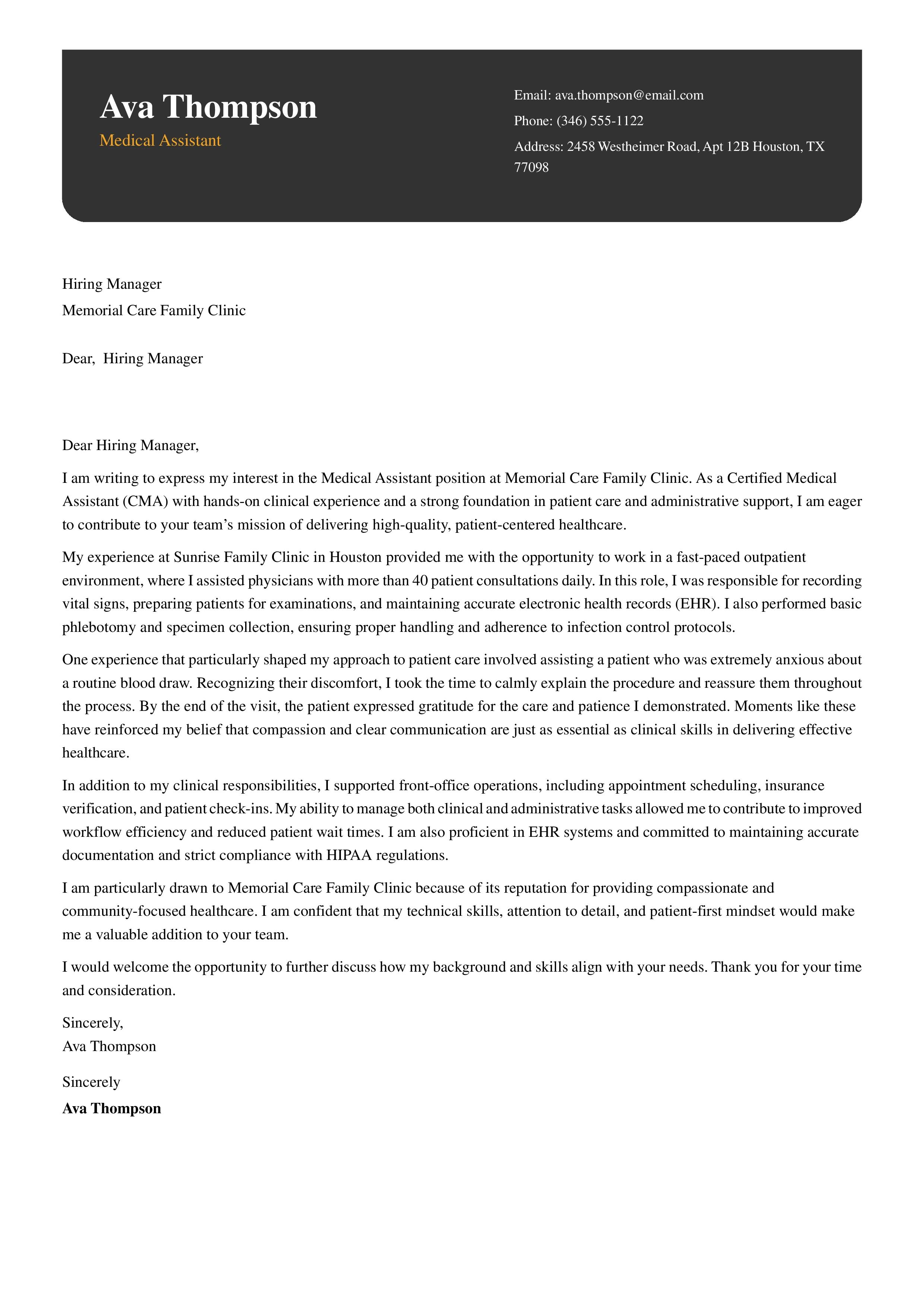
How to Create a Medical Assistant Cover Letter (Step-by-Step)
1. Enter Your Basic Details
Add your name, contact information, and the job title you’re applying for.
2. Paste the Job Description
This helps the AI identify relevant keywords like:
- Patient care
- Phlebotomy
- EHR systems
- Medical billing
3. Add Your Experience & Skills
Include your:
- Clinical experience (vital signs, assisting physicians)
- Administrative tasks (scheduling, records)
- Certifications (CMA, CPR)
4. Generate Your Cover Letter
Instaresume instantly creates a custom, role-specific cover letter.
5. Edit & Personalize
Fine-tune the tone, add achievements, and make it more personal.
FAQs – Medical Assistant Resume & Cover Letter
1. What should a medical assistant put on a resume?
A medical assistant resume should include contact information, a strong summary or objective, relevant skills (clinical and administrative), work experience, education, and certifications like CMA or CPR.
2. How do I write a medical assistant resume with no experience?
Focus on internships, clinical training, certifications, and transferable skills like communication and organization. Highlight hands-on practice during your training to show job readiness.
3. What are the most important skills for a medical assistant resume?
Key skills include phlebotomy, patient care, EHR/EMR systems, scheduling, medical billing, communication, and attention to detail.
4. How long should a medical assistant resume be?
Ideally, keep it to one page if you’re entry-level and up to two pages if you have several years of experience.
5. What certifications are required for a medical assistant?
Common certifications include Certified Medical Assistant (CMA), Registered Medical Assistant (RMA), and CPR/First Aid. Requirements may vary by employer.
6. How can I make my medical assistant resume ATS-friendly?
Use simple formatting, include keywords from the job description, avoid graphics or tables, and clearly label sections like Skills, Experience, and Education.
7. Do I need a cover letter for a medical assistant job?
Yes, a cover letter helps you stand out by showcasing your personality, patient care approach, and enthusiasm for the role.
8. How do I describe medical assistant duties on a resume?
Use action verbs and include measurable achievements. For example: “Assisted in 40+ patient visits daily” or “Reduced patient wait time by 20%.”
9. What is the best resume format for a medical assistant?
A reverse-chronological format is best, as it highlights your most recent and relevant experience first.
10. Can I use an AI tool to create my medical assistant resume and cover letter?
Yes, tools like Instaresume’s AI resume builder and cover letter generator help create ATS-friendly, job-specific documents quickly and efficiently.