
Executive assistant resume: Step-by-Step guide to land your dream job

Trust Score: 4.8
389 reviews
Table of Contents
What is an executive assistant resume?
An Executive Assistant Resume is a specialized professional document that highlights your experience, skills, and accomplishments in providing high-level administrative and executive support. Unlike a standard resume, it focuses on your ability to manage executive schedules, coordinate meetings, handle confidential information, and support the overall efficiency of an organization. For administrative professionals, having a strong Executive Assistant Resume is essential because it not only reflects your qualifications but also demonstrates your capability to perform under pressure, prioritize tasks, and contribute to organizational success.
Executive assistant resume vs CV
While the terms “resume” and “CV” are often used interchangeably, there are key differences:
 Executive Assistant Resume: Typically 1–2 pages long, this document is tailored for a specific job application. It emphasizes your relevant skills, achievements, and work experience that match the requirements of the position you are applying for. Recruiters expect it to be concise, impactful, and easy to read.
- Professional Assistant CV: A detailed, often multi-page document that includes a complete history of your education, certifications, professional experience, and other achievements. A CV is more comprehensive and is commonly used for academic, research, or government positions.
Why recruiters value a professional Executive assistant resume
Recruiters and hiring managers often receive hundreds of applications for a single Executive Assistant role. A professionally formatted resume can help you stand out from the crowd. Key reasons it matters include:
- First impressions count: A clear, well-organized resume shows that you are detail-oriented and professional.
- ATS optimization: Many companies use Applicant Tracking Systems to filter resumes. Proper formatting and strategic keyword placement ensure your resume reaches a human recruiter.
- Demonstrates relevant skills: Highlighting your administrative skills, executive support experience, and achievements gives recruiters a clear idea of how you can add value to their organization.
By understanding what an Executive Assistant Resume is and why it matters, you can create a document that not only reflects your qualifications but also improves your chances of landing interviews and ultimately securing your desired executive support role.
Why your executive assistant resume matters
Your Executive assistant resume is more than just a list of job titles and responsibilities it’s your personal brand statement and the first impression you make on recruiters. In today’s competitive job market, where hundreds of candidates apply for the same role, a strong and strategically written resume can be the deciding factor between getting shortlisted or being overlooked.
1. The Importance of a strong first impression
Recruiters spend an average of 6–8 seconds scanning each resume before deciding whether to move forward. This means your Executive Assistant Resume must immediately showcase professionalism, structure, and relevance. A well-organized layout, clear headings, and concise bullet points signal that you possess the qualities essential to executive-level support such as attention to detail, communication skills, and time management.
A polished and visually clean executive support resume reflects your ability to handle high-level administrative tasks and demonstrates your organizational strengths, which are critical for assisting top management.
2. The role of ATS in screening resumes
Most modern companies use Applicant Tracking Systems (ATS) to filter resumes before a recruiter even reads them. These systems scan for specific keywords, experience levels, and formatting patterns. If your resume lacks the right structure or relevant terms such as calendar management, scheduling, travel coordination, or executive communication, it may never reach human eyes.
That’s why it’s crucial to use an ATS-friendly resume format for Executive Assistant positions one that incorporates industry-relevant keywords, uses simple formatting (no tables or graphics), and organizes information clearly.
3. How a tailored resume increases your interview chances
A tailored Executive Assistant resume focuses on the specific needs of the company and the executive you’ll support. Instead of sending out generic resumes, customize your document for each role by aligning your skills and achievements with the job description.
For example:
- If the role emphasizes scheduling and communication, highlight how you managed complex calendars or coordinated high-level meetings.
- If the position involves project coordination, showcase examples of how you successfully handled cross-departmental initiatives.
By doing this, you demonstrate not just competence but also initiative and awareness of the employer’s priorities. This level of customization significantly increases your chances of getting interview calls and shows that you are the ideal candidate for the role.
A well-written and strategically optimized resume can open doors to new opportunities, whether you’re applying for a senior executive assistant, virtual assistant, or corporate office manager position.
Types of executive assistant resume and samples
An Executive assistant resume can vary depending on the industry, company size, and executive level you support. Tailoring your resume to match the job type helps recruiters quickly identify that you have the right experience and skill set for their needs. Below are seven high-demand Executive assistant resume examples that are most searched and relevant for different job types in 2026.
These examples demonstrate how you can highlight your executive assistant responsibilities, achievements, and professional skills based on your work environment.
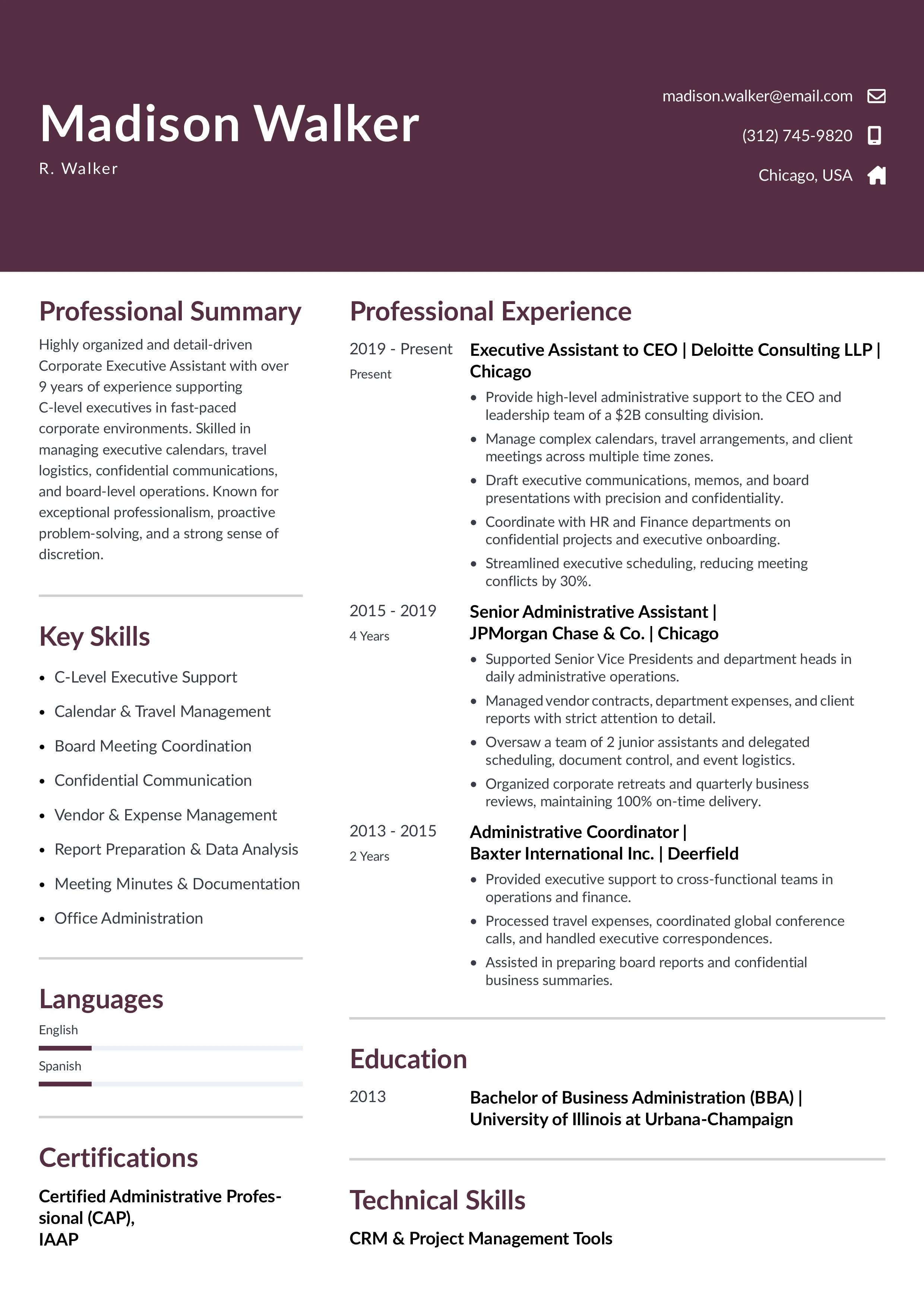
Corporate executive assistant resume example
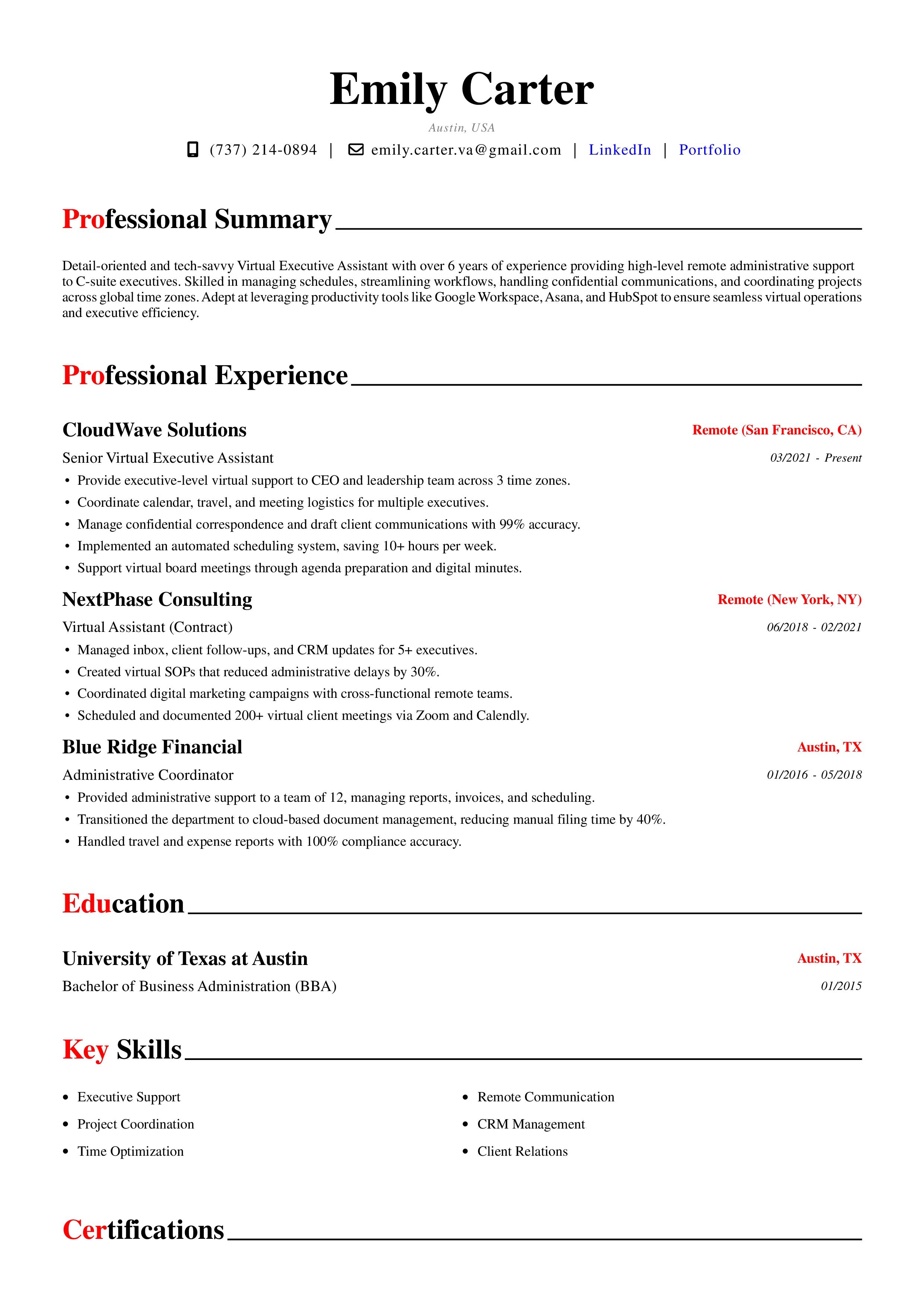
Virtual executive assistant resume example
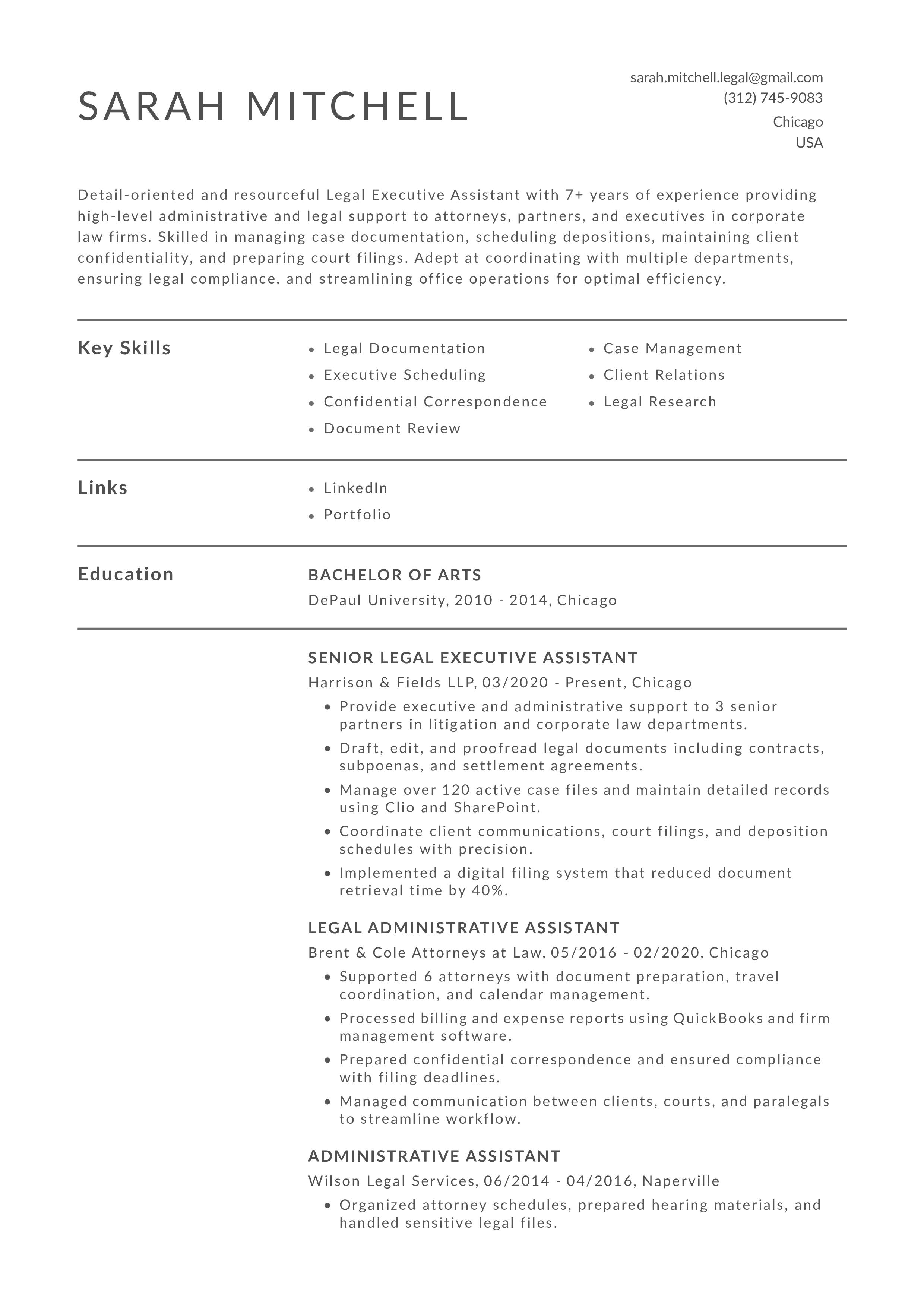
Legal executive assistant resume
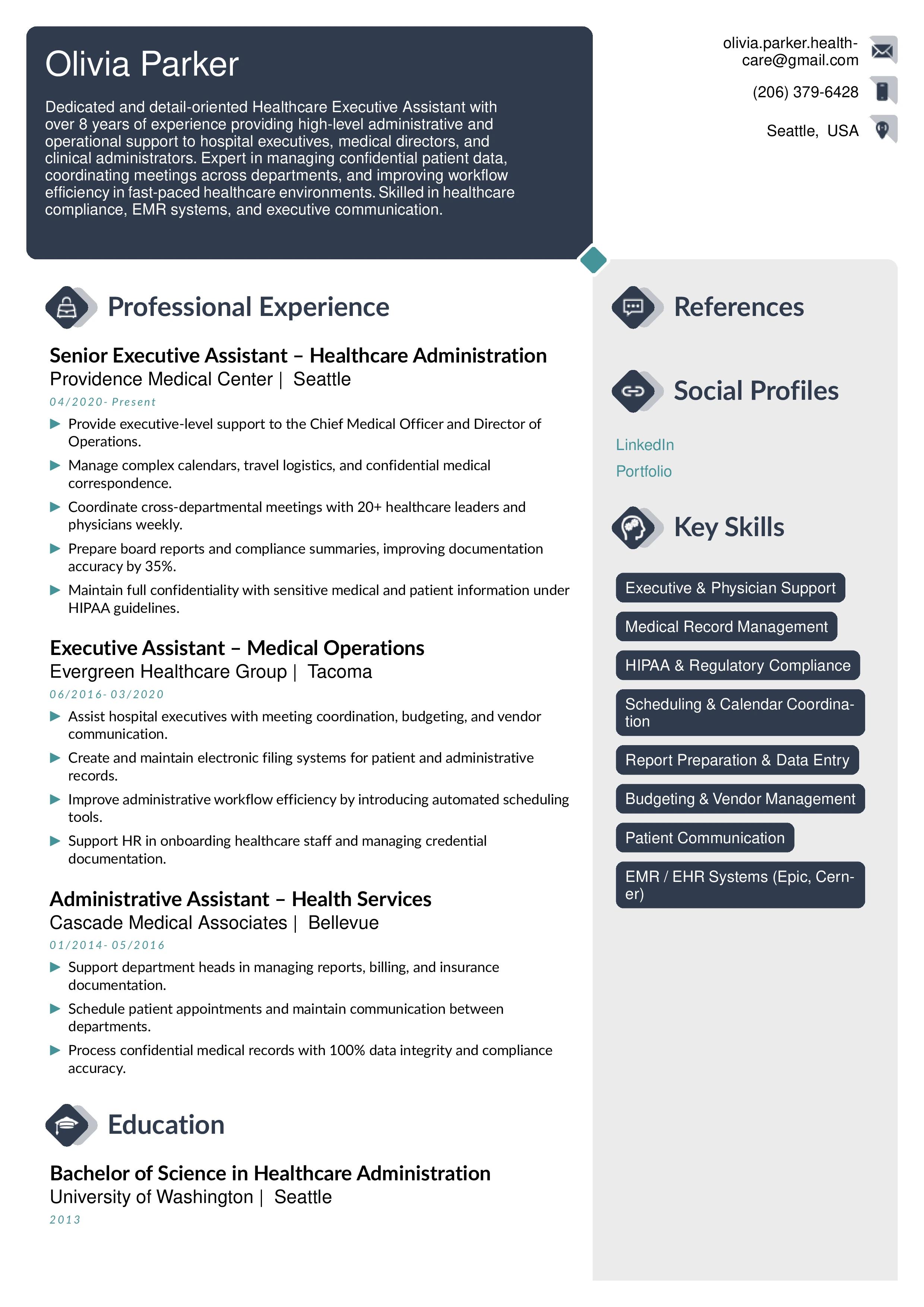
Healthcare executive assistant resume example
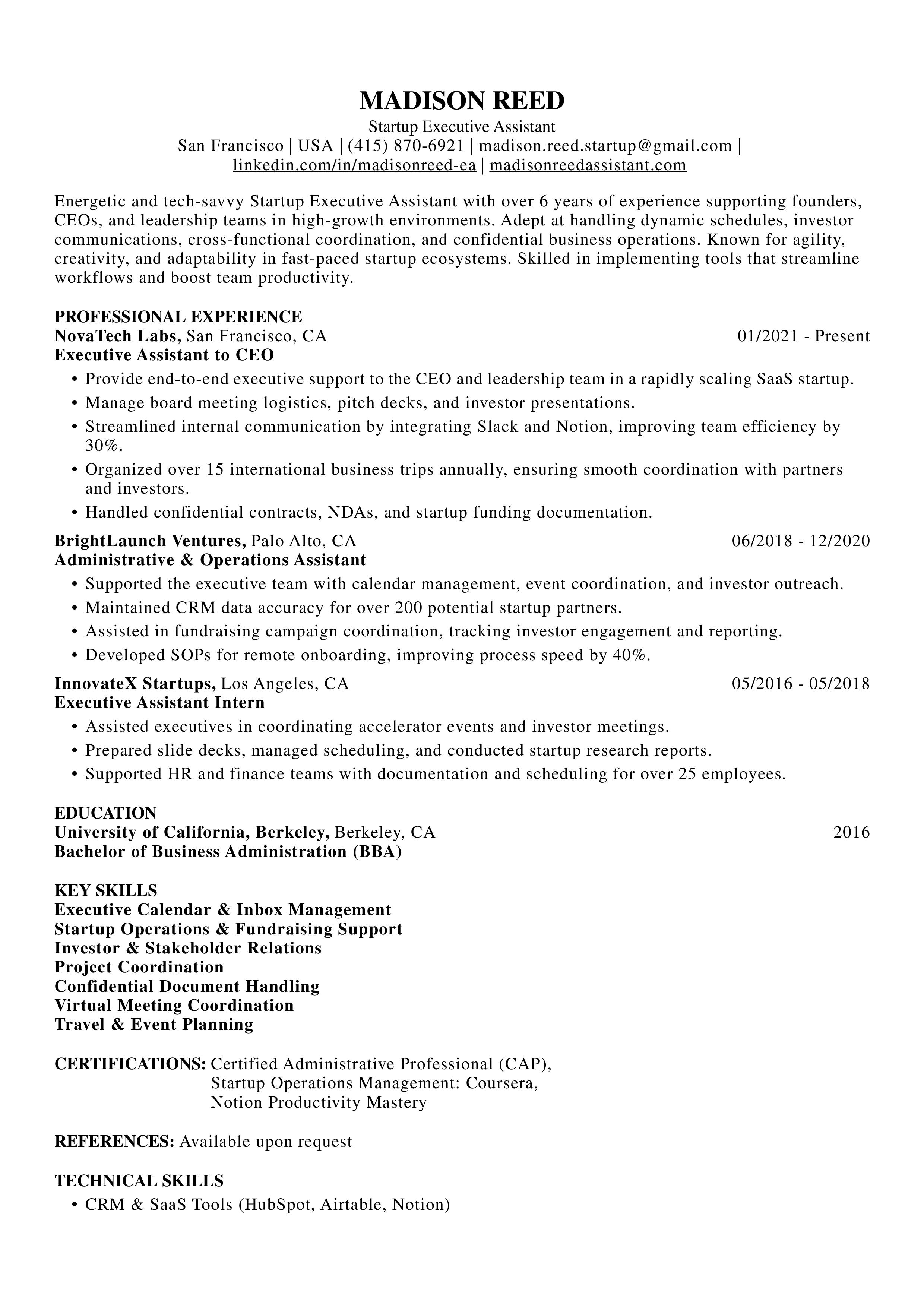
Startup executive assistant resume
How to write an executive assistant resume (step-by-step guide)
Follow this step-by-step guide to craft a professional, impactful Executive Assistant resume that gets noticed.
Step 1: Choose the right resume format
Selecting the proper resume format for an Executive Assistant role is crucial because it determines how effectively your information is presented.
Chronological resume format
Ideal for candidates with consistent experience in administrative or executive support roles. Lists your work history from most recent to oldest.
Functional resume format
Focuses on skills rather than job history suitable if you’re changing careers or re-entering the workforce.
Example:
Core Skills
• Executive calendar management
• Stakeholder communication
• Document preparation and reporting
Hybrid (Combination) resume format
Blends both approaches by emphasizing skills at the top and work history below perfect for experienced Executive Assistants.
Example:
Key Skills: Executive Support, Travel Coordination, Confidential Reporting
Professional Experience: Executive Assistant | DEF Group | 2019–Present
Step 2: Write a strong summary or objective statement
Your resume summary or objective is the first thing a recruiter reads. It should instantly communicate your value as an Executive Assistant.
For experienced candidates
Write a 2–3 line summary highlighting years of experience, industries worked in, and key achievements.
Example:
“Detail-oriented Executive Assistant with 7+ years of experience supporting C-level executives in finance and tech industries. Proven ability to manage complex calendars, coordinate global travel, and improve internal communication workflows.”
For entry-level candidates
Use an objective statement that focuses on enthusiasm, transferable skills, and a learning mindset.
Example:
“Highly organized administrative professional seeking an Executive Assistant role to leverage strong communication, scheduling, and problem-solving skills while supporting senior leadership.”
Step 3: Highlight key responsibilities and achievements
Your work experience section should do more than list duties it should showcase results. Under each role, include 3–5 bullet points describing how you made an impact.
Example:
Executive Assistant | ABC Corporation
• Managed calendars, meetings, and travel arrangements for three senior executives.
• Coordinated cross-functional meetings and prepared agendas and minutes.
• Maintained confidential documents and executive correspondence with high accuracy.
Step 4: Include measurable results and metrics
Quantifying your achievements makes them more credible and compelling. Whenever possible, include numbers and outcomes.
Examples:
• Reduced executive travel costs by 15% through optimized vendor coordination.
• Decreased scheduling conflicts by 25% by implementing a centralized calendar system.
• Handled 200+ client and internal communications per month with a 98% response rate.
Metrics clearly show how you added value an essential trait in high-performing Executive Assistants.
Step 5: Showcase essential skills
The skills section is vital for both recruiters and ATS systems. Combine hard and soft skills relevant to executive support roles.
Hard Skills
• Executive calendar management
• Travel coordination and expense reporting
• MS Office Suite (Word, Excel, PowerPoint)
• Event planning and meeting coordination
• Report preparation and data entry
Soft Skills
• Professional communication
• Multitasking and time management
• Problem-solving
• Confidentiality and discretion
• Decision-making under pressure
Step 6: Optimize for ATS and keywords
Most employers use Applicant Tracking Systems (ATS) to filter resumes. To ensure your resume passes the initial screening:
Examples of ATS-friendly practices:
• Use job-related keywords such as executive scheduling, office administration, stakeholder coordination, project support, and team management.
• Use standard headings like Professional Summary, Work Experience, and Skills.
• Avoid tables, text boxes, icons, and graphics that ATS software may not read correctly.
• Save your resume as a .docx or PDF file unless the job posting specifies otherwise.
A well-structured, keyword-optimized Executive Assistant resume with clear examples and measurable achievements significantly increases your chances of shortlisting in 2026.
Essential skills for an Executive assistant resume
An effective Executive Assistant resume should reflect strong administrative expertise, professionalism, and the ability to support senior leadership with confidence and discretion. Below are the key skills employers look for in experienced Executive Assistants.
Calendar and schedule management
Expertise in managing complex executive calendars, coordinating meetings across time zones, resolving conflicts, and ensuring optimal time utilization for senior leaders.
Professional communication
Strong written and verbal communication skills, including drafting emails, preparing correspondence, and acting as a reliable liaison between executives, stakeholders, and teams.
Confidentiality and discretion
Proven ability to handle sensitive information with integrity, maintain confidentiality, and exercise sound judgment in high-level executive environments.
Office operations and administrative support
Experience in managing day-to-day office operations, coordinating vendors, supporting internal processes, and improving administrative workflows.
Technology and tools proficiency
Advanced proficiency in Microsoft Office, Google Workspace, virtual meeting platforms, and administrative software used in executive support roles.
Travel and expense management
Skilled in arranging domestic and international travel, managing itineraries, handling expense reports, and ensuring seamless executive travel planning.
Problem solving and initiative
Ability to anticipate needs, handle urgent situations, and resolve challenges independently in fast-paced executive settings.
Time management and multitasking
Strong organizational skills with the ability to manage multiple priorities, meet deadlines, and support senior leadership efficiently.
Common mistakes to avoid in an Executive Assistant resume
Even experienced professionals can overlook details that weaken an Executive Assistant resume. Avoiding the mistakes below can significantly improve your chances of making a strong impression on hiring managers.
Using a generic resume
Submitting the same resume for every role without tailoring it to the job description can make your application look unfocused. Executive Assistant roles vary widely depending on the executive and industry.
Focusing only on duties, not impact
Listing routine tasks without showing results or outcomes reduces the strength of your resume. Employers want to see how your support improved efficiency, organization, or executive productivity.
Poor formatting and cluttered layout
Inconsistent fonts, excessive design elements, or dense paragraphs make resumes hard to scan. A clean, well-structured layout reflects strong organizational skills.
Ignoring professional summary
Skipping a concise professional summary can cause recruiters to miss your experience level and strengths at a glance, especially for senior Executive Assistant roles.
Overlooking confidentiality and trust
Failing to highlight discretion and trustworthiness is a common mistake. These qualities are essential in executive support roles and should be subtly demonstrated.
Listing outdated or irrelevant skills
Including basic or outdated skills can dilute your profile. Focus on relevant administrative, communication, and organizational strengths that align with modern executive support.
Spelling and grammar errors
Small errors can create a negative impression, especially for a role that demands attention to detail and professionalism.
Lack of clear career progression
Not showing growth or increasing responsibility over time can make your experience appear stagnant. Clear role progression adds credibility and depth.
FAQs
What should be included in an Executive Assistant resume?
An Executive Assistant resume should include a professional summary, key skills, work experience, education, and relevant certifications. It should clearly highlight executive support experience, organizational abilities, communication skills, and discretion.
How long should an Executive Assistant resume be?
For early to mid-level roles, a one-page resume is ideal. Executive Assistants with 5+ years of experience can use two pages to effectively showcase their responsibilities, achievements, and career progression.
How do I write a strong professional summary for an Executive Assistant resume?
A strong summary briefly outlines your experience level, industries supported, and core strengths such as executive support, calendar management, communication, and confidentiality.
Should I include certifications on my Executive Assistant resume?
Yes, relevant certifications such as administrative or office management credentials can strengthen your resume and demonstrate professional development.
What skills are most important for an Executive Assistant resume?
Key skills include calendar and travel management, professional communication, time management, confidentiality, problem-solving, and proficiency with office tools and software.
How can I make my Executive Assistant resume stand out?
Focus on achievements rather than tasks, maintain a clean and professional format, tailor your resume to the role, and clearly show how you supported executives and improved efficiency.
Is it necessary to customize my resume for each job application?
Yes, customizing your resume to match the job description helps highlight the most relevant skills and experience for each Executive Assistant role.