
How to write a transcriptionist resume?

Trust Score: 4.8
387 reviews
Table of Contents
Why Transcription Jobs Are in High Demand (Remote Work Growth)
The demand for transcription professionals has grown significantly due to the rapid expansion of remote work opportunities. Businesses, media companies, healthcare providers, legal firms, podcasters, and online educators constantly generate audio and video content that needs accurate documentation. From webinars and YouTube videos to court hearings and medical reports, transcription services are essential across industries.
With companies increasingly hiring remote workers to reduce operational costs, transcription has become one of the most accessible work-from-home careers. It requires minimal equipment just a computer, headphones, and strong listening skills making it an attractive option for freelancers, students, and professionals seeking flexible income.
Additionally, the rise of AI-generated content has not eliminated the need for human transcriptionists. Instead, it has increased the demand for skilled professionals who can edit, proofread, and ensure high accuracy in automated transcripts. This makes having a strong transcriptionist resume more important than ever.
Importance of a Well-Structured Transcriptionist Resume
Because transcription is a skill-based job, employers evaluate candidates primarily on measurable performance indicators such as typing speed (WPM), accuracy rate, attention to detail, and familiarity with transcription software.
A well-structured transcriptionist resume:
 Clearly highlights your typing speed and accuracy percentage
- Showcases relevant transcriptionist skills
- Demonstrates experience with audio tools and formatting standards
- Reflects professionalism and clarity (just like your transcripts should)
Since recruiters often scan resumes within seconds, your document must be clean, keyword-optimized, and ATS-friendly. A cluttered or vague resume can immediately reduce your chances even if you’re highly skilled.
What Recruiters Look for in Transcription Candidates
Hiring managers and clients typically assess transcription resumes based on the following criteria:
1. Typing Speed & Accuracy
Most employers expect 60–90 words per minute (WPM) with 95–98% accuracy.
2. Strong Language Skills
Excellent grammar, punctuation, spelling, and formatting are essential.
3. Technical Proficiency
Familiarity with tools like Express Scribe, Otter.ai, Microsoft Word, Google Docs, and time-stamping software.
4. Attention to Detail
The ability to catch subtle audio nuances, background noise distortions, and speaker distinctions.
5. Confidentiality & Professionalism
Especially critical in medical and legal transcription roles where sensitive information is involved.
6. Ability to Meet Deadlines
Turnaround time is a key performance metric in transcription jobs.
A strong transcriptionist resume must clearly demonstrate these competencies through quantifiable achievements and targeted skill sections.
What Does a Transcriptionist Do?
A transcriptionist converts spoken audio or video recordings into accurate, well-formatted written documents. These recordings may include interviews, podcasts, medical dictations, legal proceedings, business meetings, webinars, court hearings, or academic lectures.
The role goes beyond simply typing what is heard. A professional transcriptionist must ensure clarity, correct grammar, proper formatting, speaker identification, and precise timestamping when required. Accuracy and attention to detail are critical because transcripts are often used for official documentation, legal records, or published content.
Core Responsibilities of a Transcriptionist
Regardless of specialization, most transcription jobs involve:
- Listening carefully to audio recordings
- Converting speech into written format
- Editing for grammar, punctuation, and clarity
- Identifying multiple speakers accurately
- Adding timestamps (if required)
- Researching unfamiliar terminology
- Maintaining confidentiality of sensitive information
- Meeting strict turnaround deadlines
Strong transcriptionist skills such as active listening, fast typing speed, and language proficiency are essential to perform these responsibilities effectively.
Key Transcriptionist Skills Section
A strong transcriptionist resume must clearly separate technical skills and soft skills. Since this is a performance-driven job, employers expect measurable abilities supported by tools and language expertise. Below is how you can structure this section in your blog.
A. Technical Skills
Technical skills are the backbone of any transcriptionist role. Recruiters often scan this section first.
1️⃣ Typing Speed (WPM)
Typing speed is one of the most critical transcriptionist skills.
- Industry standard: 60–90 words per minute (WPM)
- Competitive candidates: 80+ WPM
- Always mention your exact speed in your resume
✅ Example for resume:
2️⃣ Accuracy Rate (95%+)
Accuracy is even more important than speed. Employers typically expect:
- 95–98% accuracy minimum
- 98%+ for medical and legal transcription
Your transcriptionist bio should clearly state your accuracy percentage.
✅ Example:
3️⃣ Audio Transcription Software
Familiarity with professional tools increases credibility. Mention tools such as:
- Express Scribe
- Otter.ai
- oTranscribe
- Descript
- Rev platform
- Sonix
Recruiters prefer candidates who can adapt to different client systems quickly.
4️⃣ MS Word / Google Docs
Most transcripts are delivered in document format. You must know:
- Formatting standards
- Headers and timestamps
- Track changes
- Template usage
Highlight document formatting proficiency clearly.
5️⃣ Time Stamping
Time stamping is crucial for interviews, research, and legal documentation.
Skills include:
- Manual timestamp insertion
- Automated timestamp tools
- Speaker labeling
- Formatting consistency
B. Soft Skills
While technical ability gets you shortlisted, soft skills make you reliable and professional.
1️⃣ Attention to Detail
Transcription requires catching subtle audio differences, background noise, and speaker transitions.
2️⃣ Listening Skills
Strong active listening helps identify:
- Accents
- Low-volume speech
- Overlapping dialogue
3️⃣ Time Management
Turnaround time is a major performance metric in transcription jobs. Employers value candidates who consistently meet deadlines.
4️⃣ Confidentiality & Data Protection
Especially important in medical and legal transcription. You must demonstrate:
- Ethical handling of sensitive data
- Secure document sharing practices
5️⃣ Grammar and Punctuation Expertise
Strong command over language ensures clean, publish-ready transcripts. Employers look for:
- Correct sentence structuring
- Proper punctuation
- Spelling accuracy
- Formatting consistency
⭐ Nice-to-Have Skills
These skills can significantly increase your earning potential and specialization opportunities.
✔ Medical Terminology Knowledge
Essential for medical transcription roles. Increases eligibility for healthcare clients.
✔ Legal Terminology Knowledge
Important for court transcription, depositions, and law firm documentation.
✔ Multilingual Transcription
If you can transcribe multiple languages, highlight it prominently. It opens global opportunities.
✔ Captioning & Subtitling
Knowledge of SRT files, subtitle formatting, and caption timing is highly valuable for media and content creators.
5+ Transcriptionist resume examples Free Edit and Download
📄 Entry-Level General Transcriptionist Resume Example
Edit this template while clicking on the button below using our AI Resume Builder.
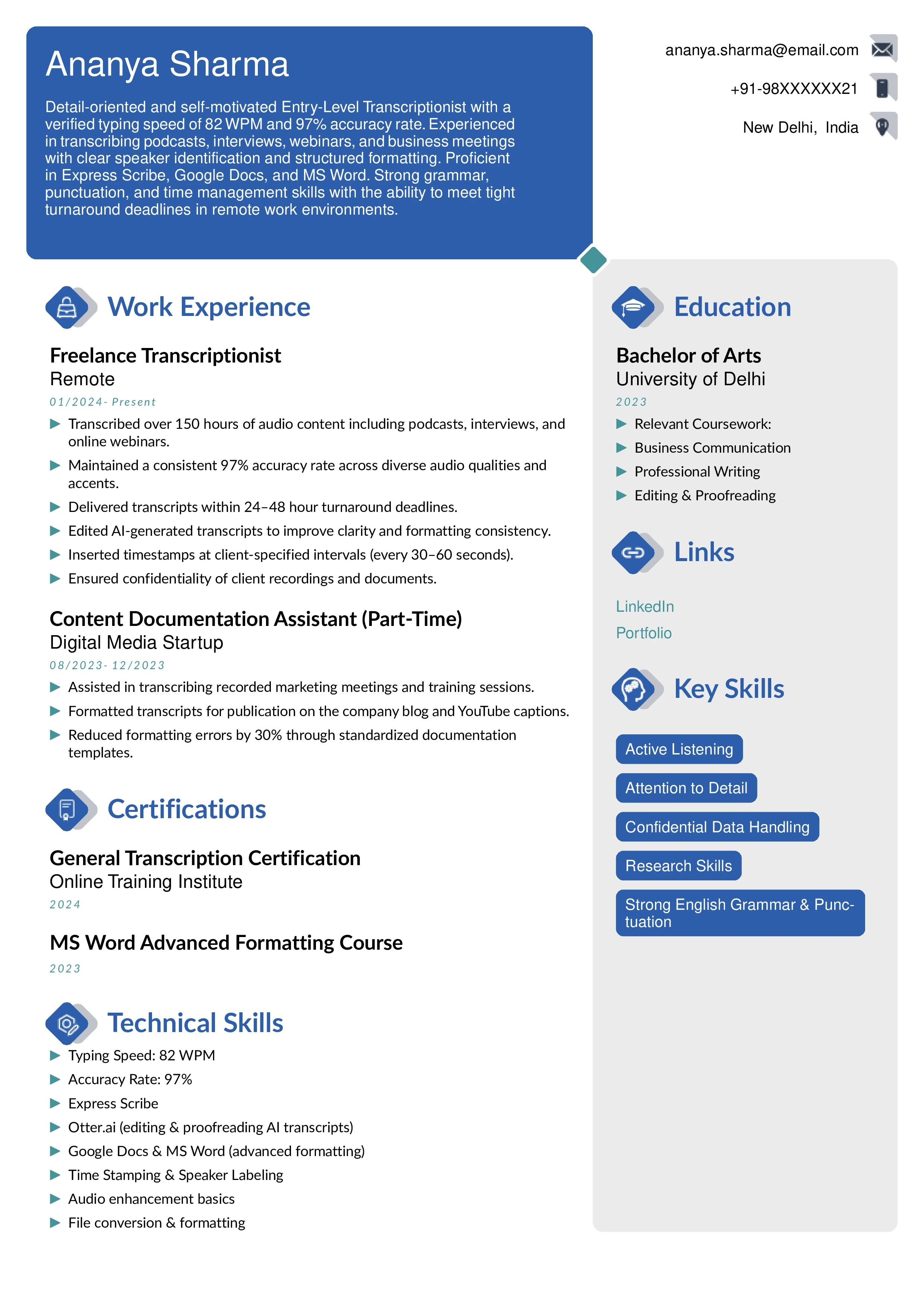
Why This Resume Is Ideal for Entry-Level General Transcription Roles
This resume works exceptionally well for entry-level positions because:
✔ Clearly states typing speed and accuracy (top hiring criteria)
✔ Includes measurable freelance experience (150+ hours transcribed)
✔ Demonstrates familiarity with industry tools
✔ Shows remote readiness and deadline reliability
✔ Highlights editing AI-generated transcripts (modern industry relevance)
✔ Keeps formatting clean and ATS-friendly
It avoids the common beginner mistake of being too generic. Instead, it focuses on performance metrics, software familiarity, and real project exposure exactly what remote transcription clients look for.
📄 Medical Transcriptionist Resume Example
Edit this template while clicking on the button below using our AI Resume Builder.
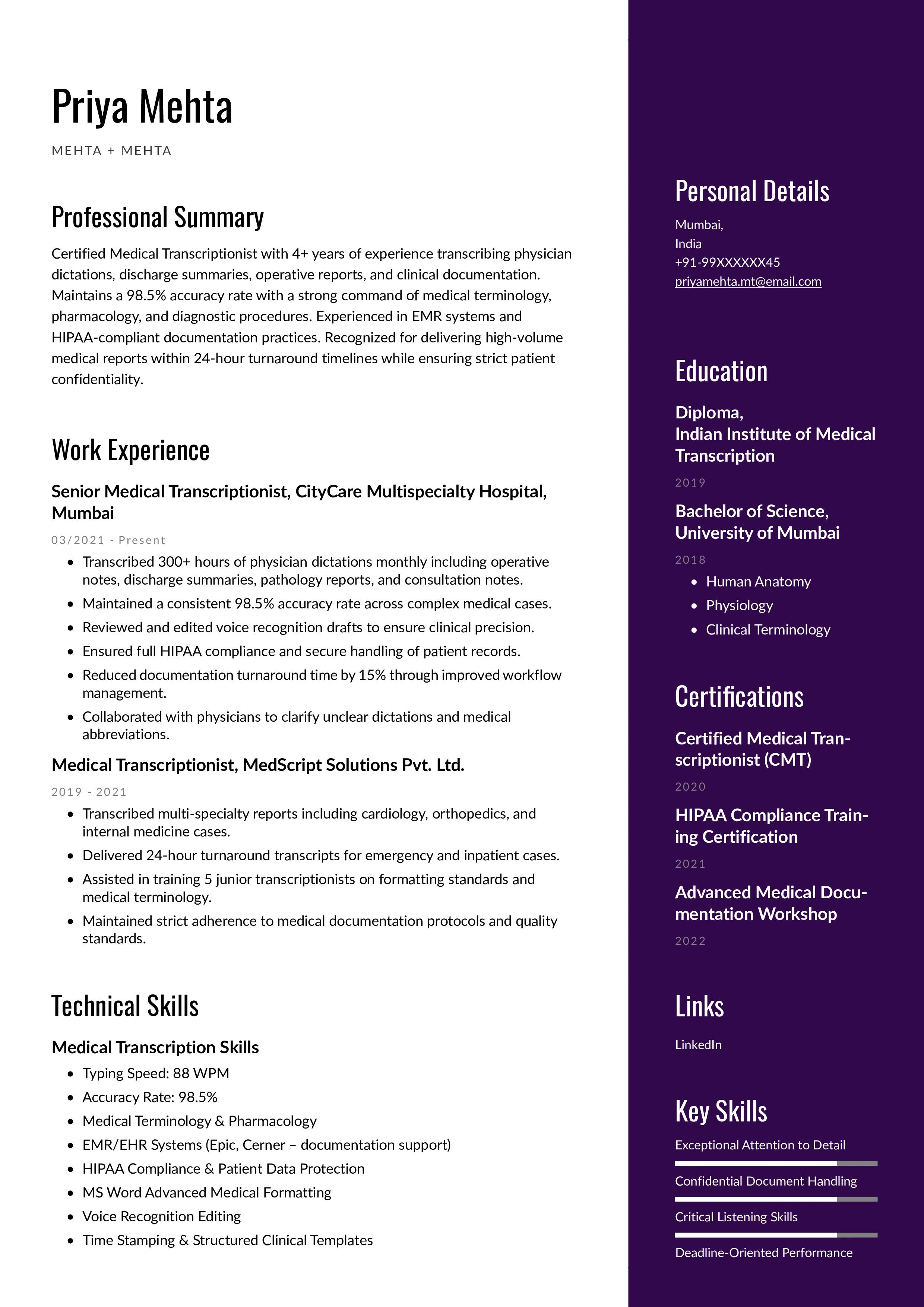
Why This Resume Is Ideal for Medical Transcription Roles
This resume stands out because:
✔ Clearly emphasizes certification and specialization
✔ Quantifies accuracy rate (98.5%) and workload volume (300+ hours/month)
✔ Mentions HIPAA compliance — a critical hiring keyword
✔ Demonstrates experience with EMR systems (important technical requirement)
✔ Shows measurable improvements (15% turnaround reduction)
✔ Includes relevant healthcare education background
Unlike a general transcription resume, this version highlights clinical expertise, compliance awareness, and medical terminology proficiency exactly what healthcare employers prioritize.
📄 Legal Transcriptionist Resume Example
Edit this template while clicking on the button below using our AI Resume Builder.
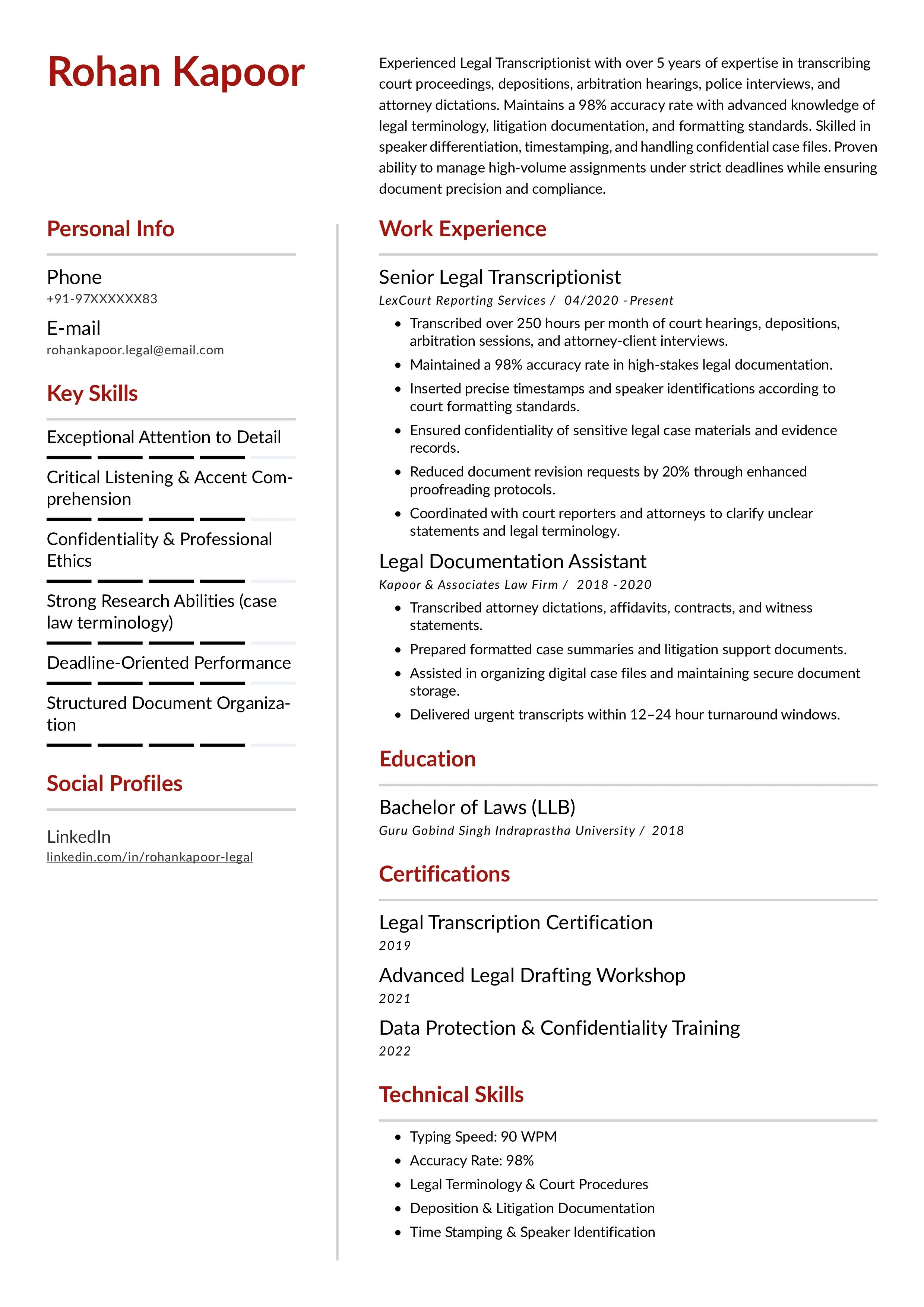
Why This Resume Is Ideal for Legal Transcription Roles
This resume works exceptionally well for legal transcription jobs because:
✔ Clearly emphasizes legal terminology expertise
✔ Quantifies workload (250+ hours/month)
✔ Highlights confidentiality and ethical handling of case files
✔ Demonstrates familiarity with court formatting standards
✔ Shows measurable performance improvements (20% fewer revisions)
✔ Includes relevant legal education (LLB), strengthening credibility
Unlike general transcription resumes, this version focuses heavily on precision, legal documentation structure, compliance, and confidentiality the core priorities for law firms and court reporting agencies.
Freelance Transcriptionist Resume
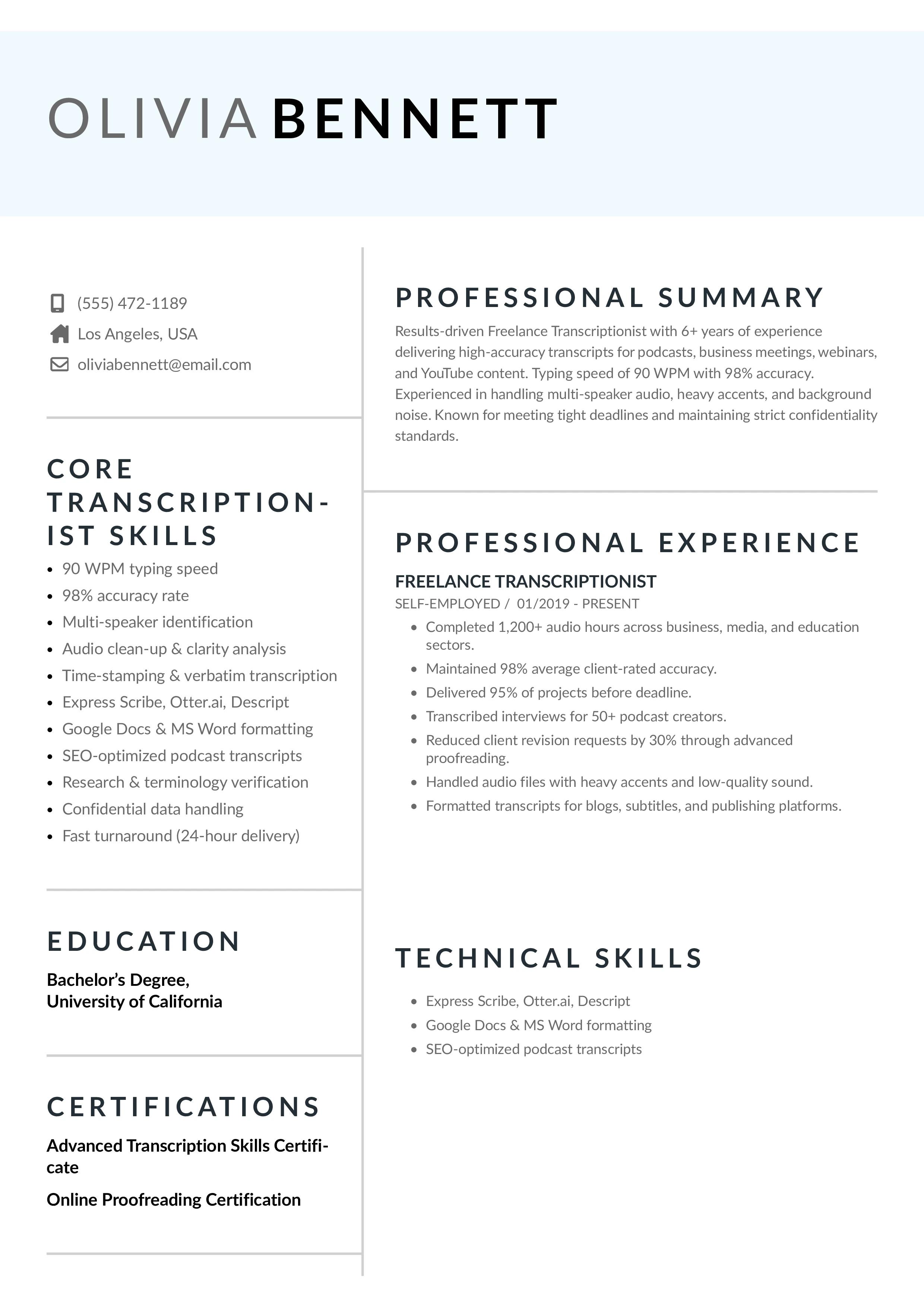
Why This Resume Works Perfectly
✔ Quantifiable achievements (1,200+ hours, 98% accuracy, 95% on-time rate) build trust instantly.
✔ Strong transcriptionist skills section with both technical and soft skills.
✔ Includes software tools employers search for (ATS optimized).
✔ Demonstrates niche value (SEO transcripts, SaaS webinars).
✔ Portfolio link builds credibility for freelance hiring.
This resume clearly positions the candidate as a professional, reliable, and results-oriented freelancer exactly what remote clients want.
Captioning & Subtitling Transcriptionist Resume
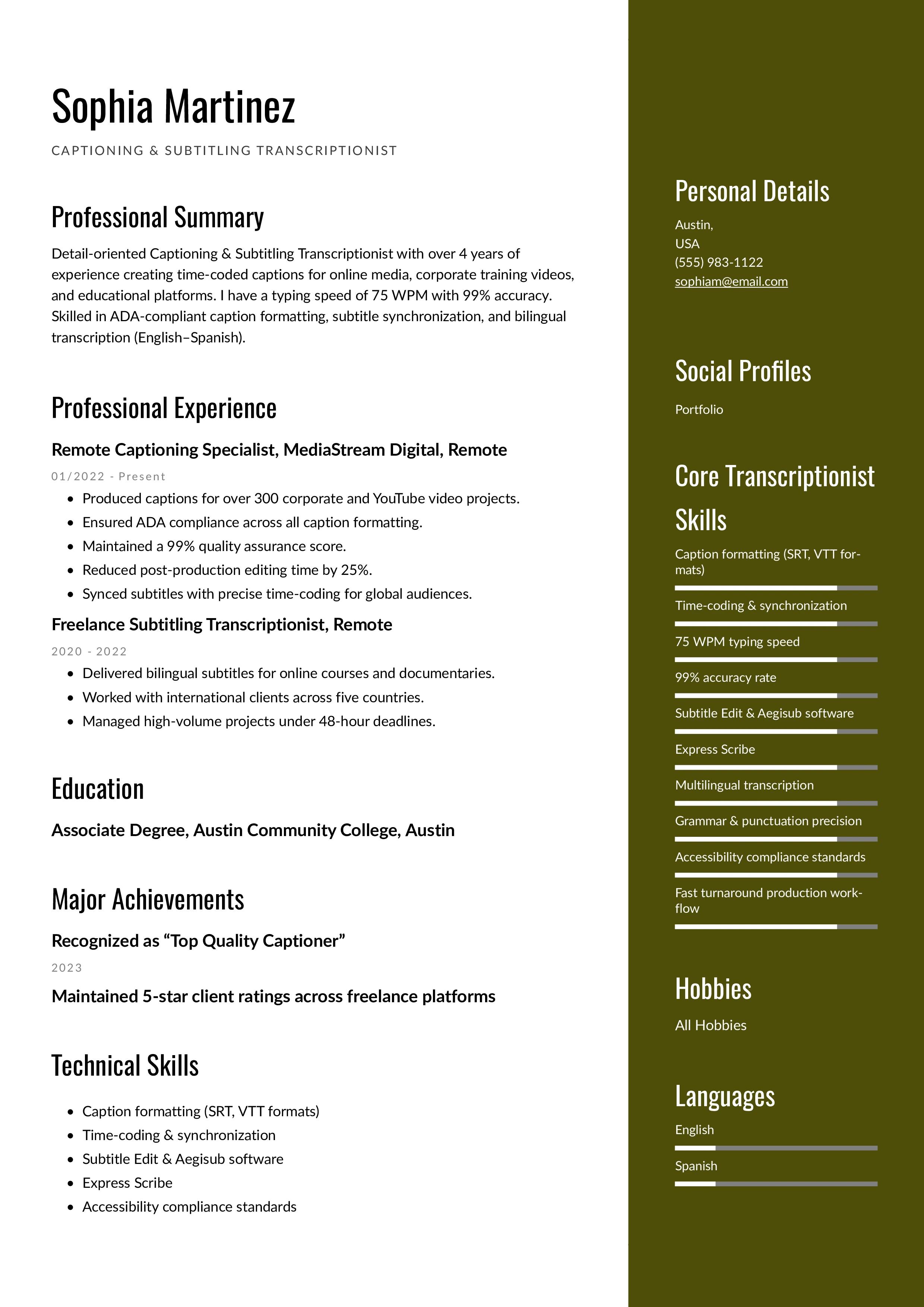
Why This Resume Works Perfectly
✔ Clearly differentiates from general transcription by focusing on captioning & accessibility.
✔ Highlights industry-specific tools (SRT, VTT, Subtitle Edit).
✔ Shows measurable impact (300+ videos, 99% QA score, 25% faster production).
✔ Emphasizes bilingual ability a strong competitive advantage.
✔ Demonstrates compliance knowledge (ADA standards), which employers value highly.
This resume works because it positions the candidate as a specialized expert, not just a typist making it more competitive in the remote job market.
3+ Transcription Cover Letter Examples Free Edit and Download
Writing a strong transcription cover letter can feel overwhelming — especially when you’re trying to highlight typing speed, accuracy rate, transcriptionist skills, and software expertise in a professional tone.
Instead of struggling with structure and wording, you can instantly generate a tailored, job-ready cover letter using the Instaresume AI Cover Letter Generator. It helps you:
✔ Customize your cover letter based on the job description
✔ Highlight key transcriptionist skills automatically
✔ Present typing speed and accuracy professionally
✔ Maintain a clean, employer-ready format
✔ Save hours of manual writing and editing
Now, here’s an example of a professionally structured cover letter generated for an Entry-Level Remote Transcriptionist role:
📄 Cover Letter Example – Entry-Level General Transcriptionist
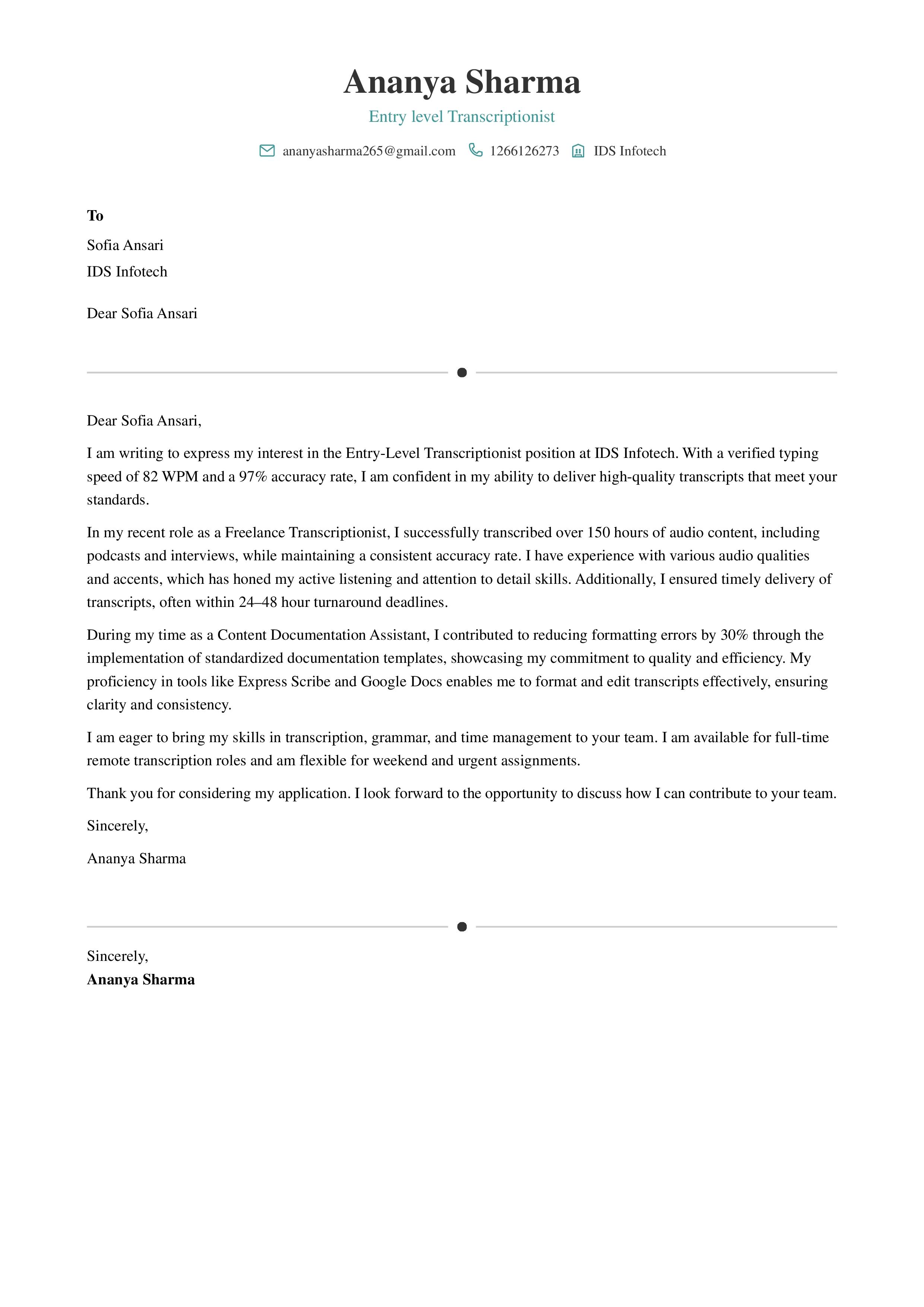
Why This Cover Letter Converts Well
✔ Immediately highlights typing speed and accuracy
✔ Shows measurable transcription experience
✔ Mentions tools and formatting standards
✔ Demonstrates professionalism and reliability
✔ Maintains clarity and structure recruiters prefer
Freelance Transcriptionist
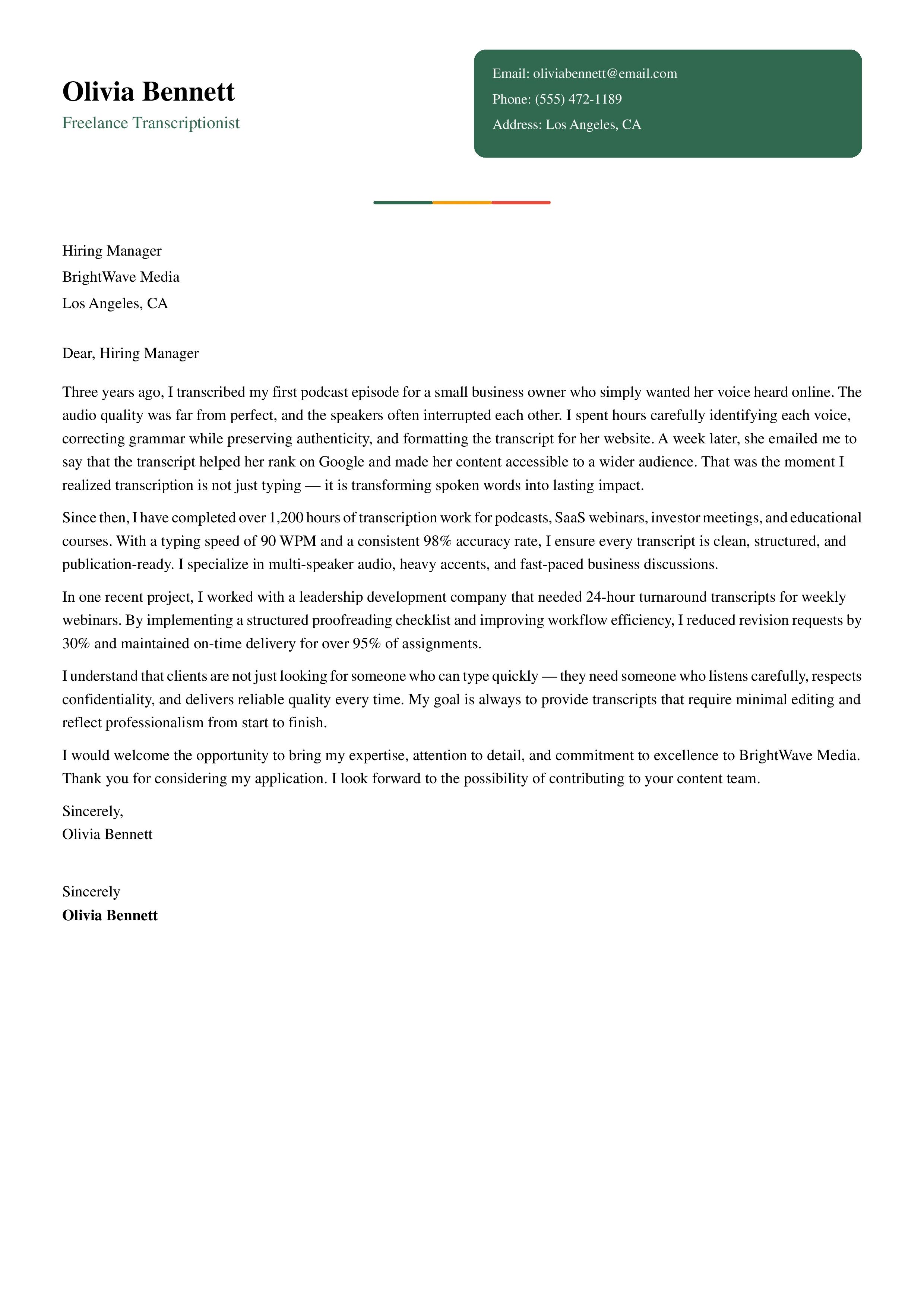
Why This Cover Letter Works Perfectly
✔ Opens with a realistic story that shows passion and growth.
✔ Demonstrates measurable achievements (1,200+ hours, 98% accuracy, 30% fewer revisions).
✔ Connects transcription work to business value (SEO, accessibility, efficiency).
✔ Shows reliability and professionalism — key for freelance roles.
✔ Ends with confidence and a strong closing statement.
Captioning & Subtitling Transcriptionist
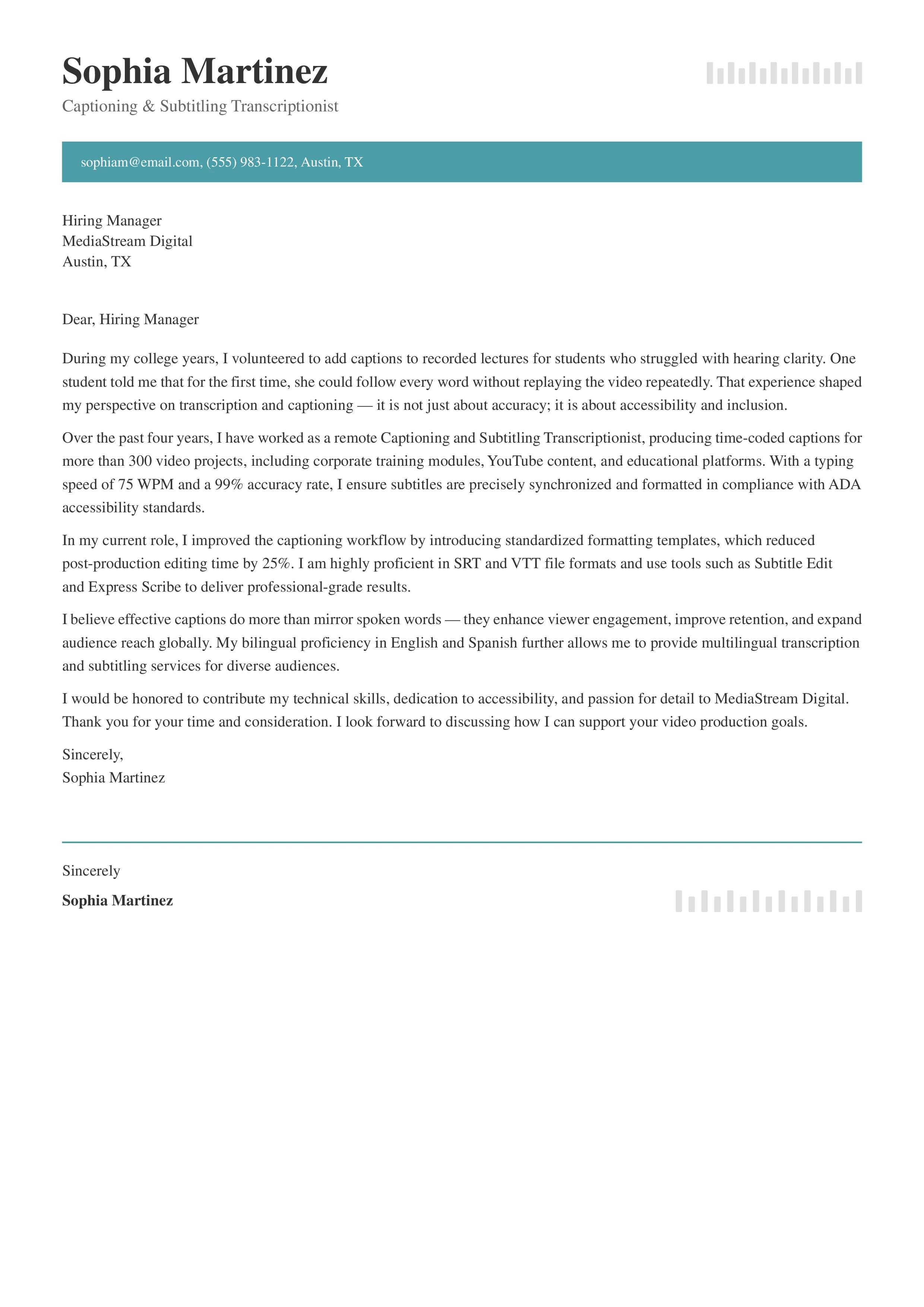
Why This Cover Letter Works Perfectly
✔ Begins with a meaningful personal story tied to accessibility.
✔ Highlights measurable achievements (300+ projects, 99% accuracy, 25% workflow improvement).
✔ Shows specialization (ADA compliance, SRT/VTT formats).
✔ Demonstrates emotional intelligence and professionalism.
✔ Positions the candidate as a specialist, not just a typist.
Frequently Asked Questions (FAQs)
1️⃣ What should I include in a transcriptionist resume?
A transcriptionist resume should include:
- Professional summary (transcriptionist bio)
- Typing speed (WPM)
- Accuracy rate (95% or higher)
- Transcription software proficiency
- Work experience (freelance or full-time)
- Education and certifications
- Technical and soft transcriptionist skills
Employers prioritize measurable performance metrics like typing speed and accuracy over generic statements.
2️⃣ How do I write a strong transcriptionist bio?
A strong transcriptionist bio should:
- Mention typing speed
- Include accuracy percentage
- Highlight specialization (general, medical, or legal)
- State software proficiency
- Emphasize attention to detail and deadline management
Keep it concise (3–4 lines) and results-focused.
3️⃣ What typing speed is required for a transcription job?
Most employers require:
- Minimum: 60 WPM
- Competitive: 75–90 WPM
- Medical/Legal roles: 80+ WPM preferred
However, accuracy (95–98%) is often more important than speed.
4️⃣ What are the most important transcriptionist skills?
The most important transcriptionist skills include:
- Active listening
- Attention to detail
- Grammar and punctuation expertise
- Time management
- Familiarity with transcription software
- Confidentiality handling
For specialized roles, medical or legal terminology knowledge is also required.
5️⃣ Can I get a transcription job with no experience?
Yes. Many entry-level general transcription jobs accept beginners if you:
- Demonstrate strong typing speed
- Show high accuracy
- Complete transcription certifications
- Build a small freelance portfolio
Highlight transferable skills such as proofreading, content writing, or documentation support.
6️⃣ How do I make my transcription resume stand out?
To stand out:
- Add measurable achievements (e.g., “Transcribed 150+ audio hours”)
- Mention exact accuracy rate
- Include transcription tools used
- Show turnaround time performance
- Tailor your resume to the job description
Specific metrics make a stronger impression than generic statements.
7️⃣ Do medical and legal transcriptionists need certifications?
While not always mandatory, certifications significantly improve job prospects in specialized roles. Healthcare employers especially prefer certified candidates due to compliance and documentation standards.
8️⃣ How long should a transcriptionist resume be?
- Entry-level: 1 page
- Experienced professionals: 1–2 pages
Keep formatting clean and avoid unnecessary graphics or unrelated experience.
9️⃣ Is transcription still in demand with AI tools available?
Yes. While AI can generate automated transcripts, human transcriptionists are needed to:
- Edit and proofread AI drafts
- Ensure high accuracy
- Correct formatting and speaker identification
- Handle complex audio and specialized terminology
Human review remains essential in medical and legal settings.
🔟 How can I quickly create a professional transcription cover letter?
Instead of writing from scratch, you can use the AI-powered cover letter generator from Instaresume to instantly create a tailored, professional cover letter based on your resume and job description. It helps structure your content clearly while highlighting your key transcriptionist skills.