
Finance Resume Template Free Download: ATS-Friendly & Professional

Trust Score: 4.8
387 reviews
Table of Contents
Introduction: Why you need a Free finance resume template in 2025
The finance job market in 2025 is more competitive than ever. Whether you’re applying for roles in banking, accounting, financial analysis, or corporate finance, your resume is the first impression you make on recruiters. A professional finance resume not only highlights your skills and achievements but also sets you apart from hundreds of other applicants.
Importance of a Professional finance resume
A strong finance resume demonstrates that you:
 Pay attention to detail – a key skill in finance
- Understand industry requirements – highlighting technical and analytical skills
- Can showcase measurable achievements – like cost savings or revenue growth
A generic or poorly formatted resume can instantly reduce your chances of moving forward in the hiring process. In finance, where accuracy and clarity matter most, your resume reflects your professional credibility.
How ATS (Applicant Tracking System) filters resumes
Before your resume reaches a hiring manager, it often passes through an Applicant Tracking System (ATS). These systems scan resumes for:
- Finance-specific keywords (e.g., Budgeting, Risk Management, Financial Analysis)
- Proper formatting that ATS can read
- Relevant job titles and experience levels
If your resume has complex designs or missing keywords, it may be rejected automatically, no matter how skilled you are.
Tip: Using an ATS-friendly finance resume template ensures that your application passes the initial filter and reaches human recruiters.
What makes a great finance resume? (With real examples)
A great finance resume is more than just a list of jobs it’s a strategic document that convinces recruiters you’re the perfect fit. In a field where accuracy and results matter, your resume should be:
- Clean and Professional – No flashy designs that confuse ATS
- ATS-Friendly – Passes Applicant Tracking System scans easily
- Focused on Quantifiable Achievements – Show how your work impacted revenue, cost savings, or efficiency
Remember: Recruiters love numbers! A finance resume with measurable results gets noticed faster than a generic description of duties.
Must-Have Sections in a Finance Resume
To create the best finance resume format, include these essential sections:
Contact Information
- Name, phone, professional email, LinkedIn profile
- Optional: city & state (for location preference)
Professional Summary (2–3 lines)
- A concise snapshot of your experience, skills, and career focus
- Example:
“Detail-oriented Financial Analyst with 4+ years of experience in budget forecasting, variance analysis, and cost optimization. Skilled in Excel, SAP, and risk assessment.”
Finance Skills (Technical + Analytical)
- Include core skills and tools like:
- Financial Reporting
- Budgeting & Forecasting
- Risk Analysis
- SAP, QuickBooks, Advanced Excel
Certifications (CFA, CPA, FRM)
- Finance recruiters prioritize certified professionals
- Examples:
- CFA Level II Cleared
- CPA Certified Public Accountant
- FRM Financial Risk Manager
Work Experience with Measurable Results
- Focus on achievements, not just responsibilities
- Use metrics to show your impact
Education
Include degrees, finance-related coursework, or academic projects
Free Finance Resume Templates by Job Role
Every finance role demands a slightly different resume. A banking professional won’t highlight the same skills as a financial analyst or finance manager.
To make things easy, here are free, ATS-friendly finance resume templates for different positions.
Scroll through, pick your role, and download the template to customize.
Free financial analyst resume template (ATS-friendly example)
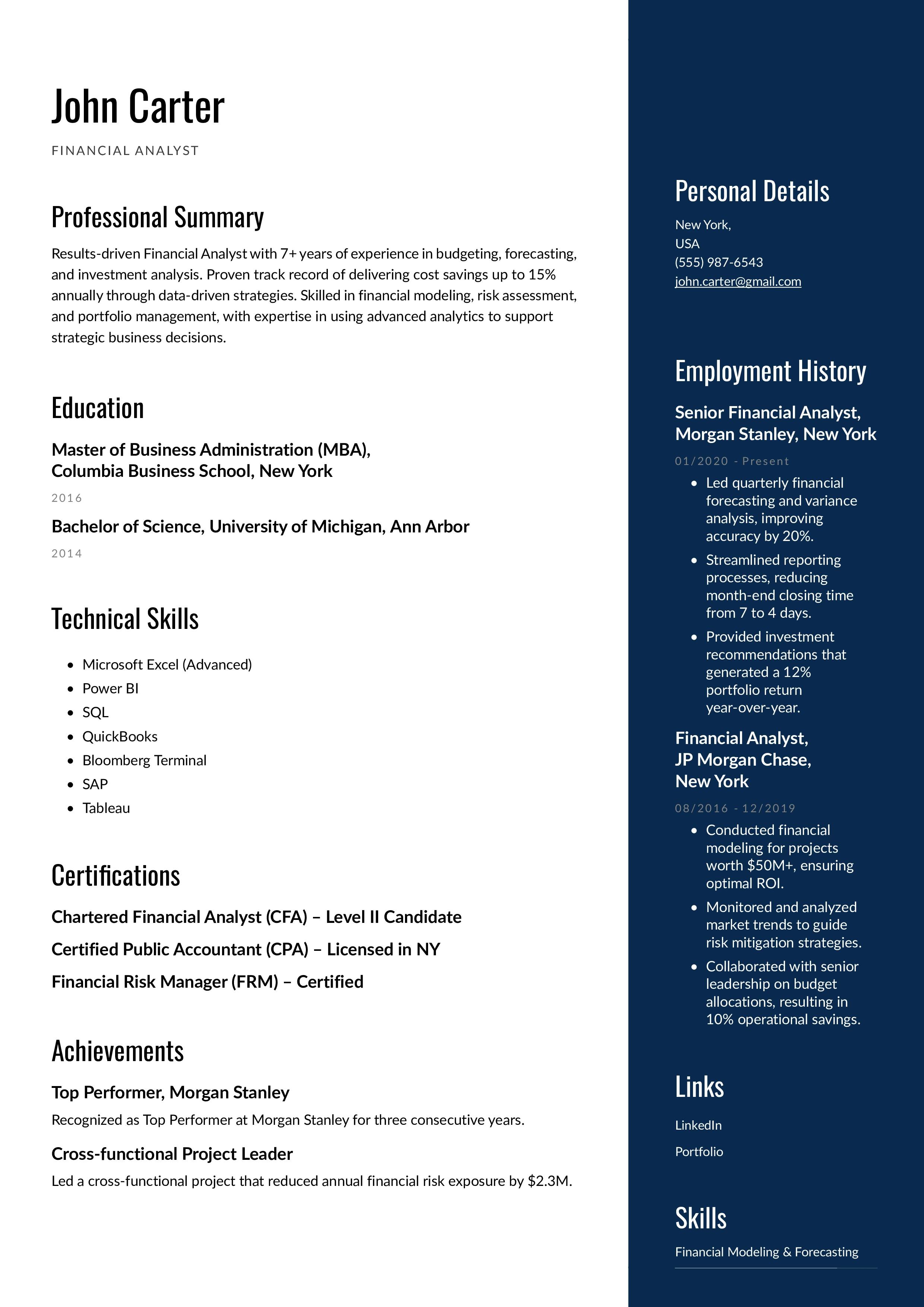
Resume highlights-
- Delivered data-driven financial insights through budgeting, forecasting, and variance analysis.
- Reduced operational costs by 9–24% through cost-optimization strategies.
- Automated financial dashboards, cutting manual reporting time by 40–45%.
- Improved cash-flow efficiency by reducing DSO by up to 12 days.
- Partnered closely with CFOs and senior leadership on strategic decision-making.
- Strengthened internal controls, reducing financial risk exposure by 20%+.
- Led multi-division budgeting with combined budgets exceeding USD 85M.
- Built and maintained advanced financial models to support long-term planning.
Accountant resume template free download
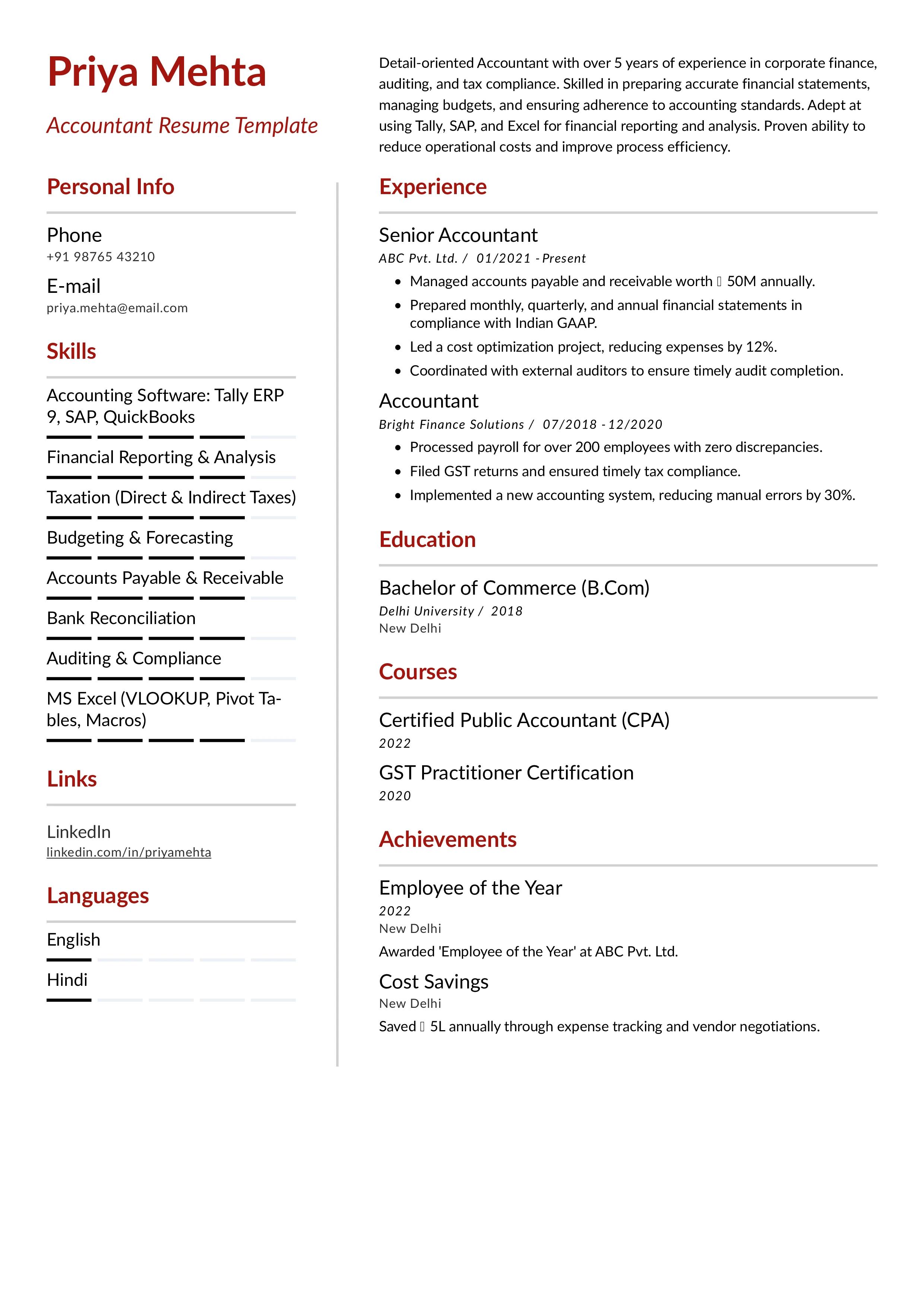
Resume highlights-
- Prepared and reviewed 200+ accounts with zero discrepancies.
- Filed GST and statutory returns with 100% on-time compliance.
- Reduced accounting errors by 30% through ERP implementation.
- Led audit coordination and ensured timely audit completion.
- Managed AP/AR, bank reconciliation, and month-end closings.
- Applied direct and indirect tax knowledge to minimize compliance risks.
Banking resume template (For investment & Retail banking)
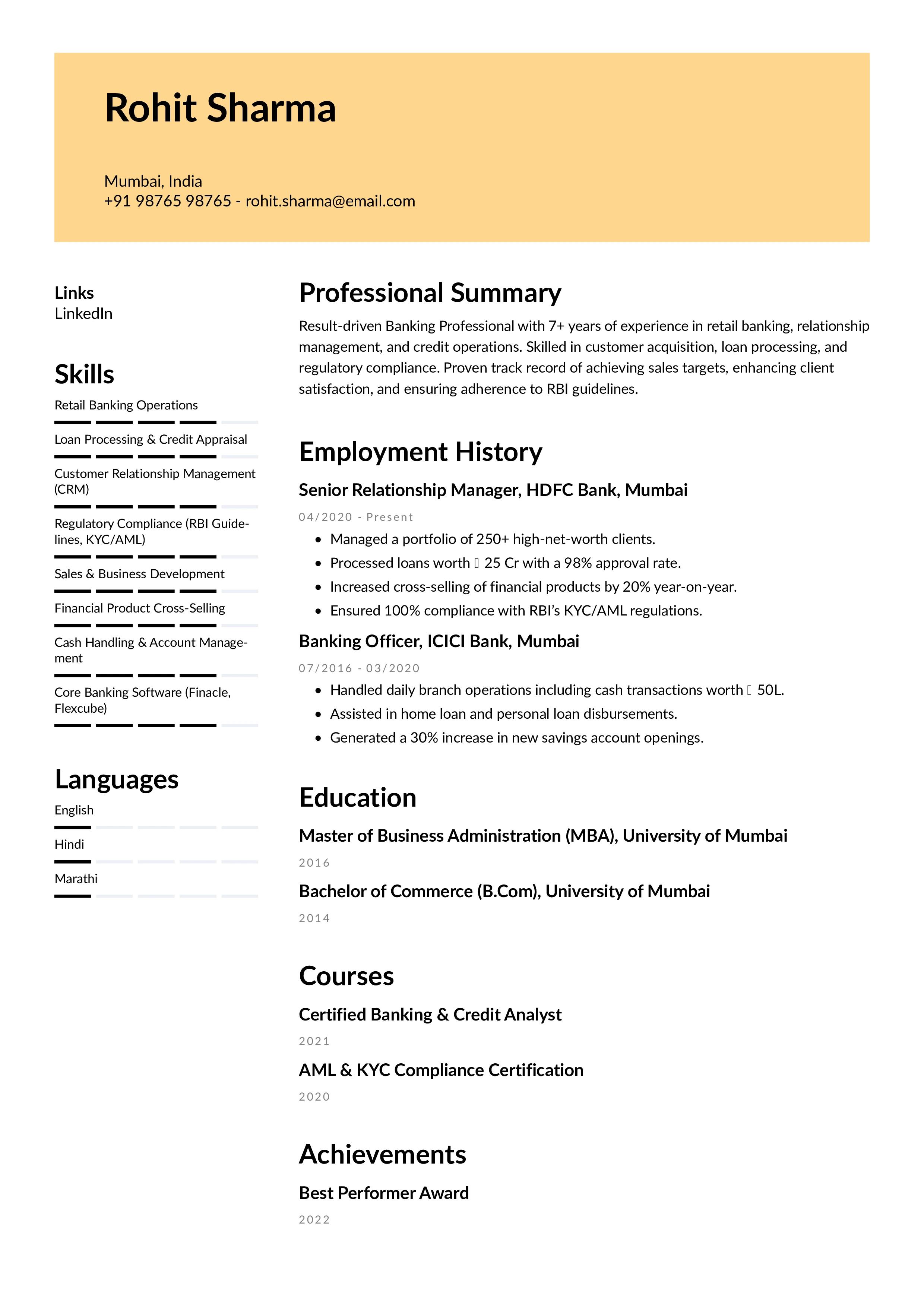
Resume highlights-
- Led quarterly and annual financial planning for enterprise-scale organizations.
- Streamlined reporting processes, reducing closing cycles from 7 to 4 days.
- Provided investment recommendations generating 12%+ portfolio returns.
- Conducted financial modeling for projects worth $50M+.
- Delivered executive-level insights using tools like Power BI, Tableau, SAP.
Finance manager resume template free (Leadership role example)
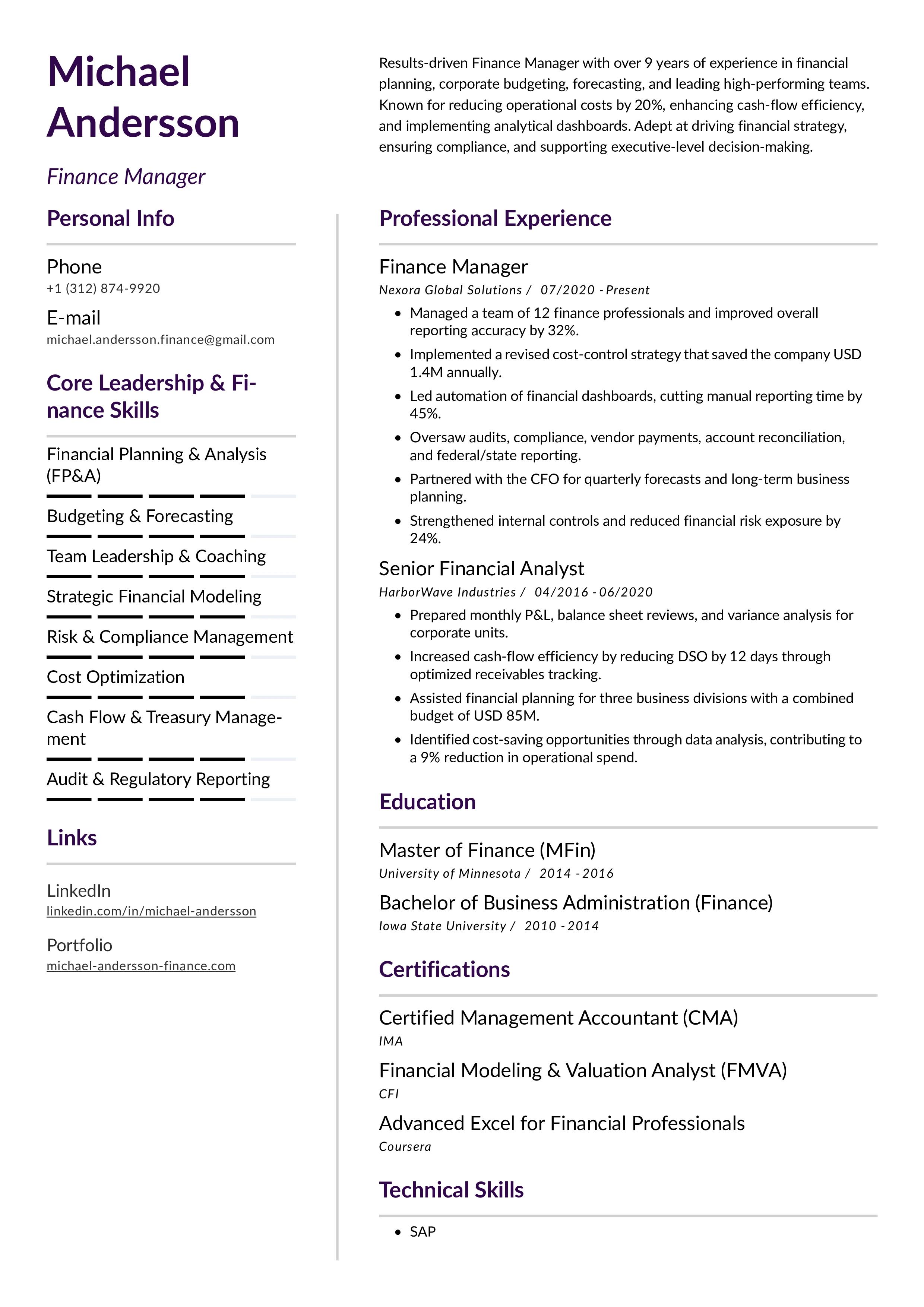
Resume highlights-
- Managed high-value banking portfolios with 95%+ client retention.
- Processed loan portfolios exceeding ₹25 Cr with high approval success.
- Increased cross-selling of financial products by 20–30% YoY.
- Ensured 100% compliance with RBI KYC/AML regulations.
- Handled daily branch operations and large-scale cash transactions.
- Drove new account acquisition and improved customer satisfaction metrics.
How to write a finance resume
Downloading a finance resume template is a great start, but to stand out to recruiters and pass ATS filters, you need to customize it properly. Here’s a simple step-by-step process to make your resume professional and job ready.
Step 1: Pick the Right Template for Your Role
The first step is choosing a template that matches your job target and experience level. Using the wrong template can make your resume look generic.
Pointers:
- Freshers → Use Financial Analyst or Accountant templates
- Experienced professionals → Choose Banking or Finance Manager templates
- Avoid sending the same resume to all finance roles
Step 2: Replace Placeholder Text with Real Experience
Templates often come with dummy text. Replace it with specific roles, achievements, and responsibilities from your experience. Keep it short, clear, and action oriented.
Pointers:
- Don’t write: Responsible for financial analysis
- Do write: Performed quarterly variance analysis, reducing costs by 8%
- Focus on what you achieved, not just what you did
Step 3: Add Numbers to Show Impact
Recruiters notice resumes that prove results with numbers. Quantifiable achievements make your profile look credible and result-driven.
Pointers:
- Reduced budget variance by $200K
- Increased forecasting accuracy by 15%
- Optimized reporting process to save 10 hours per month
Step 4: Highlight Core Finance Skills & Tools
A dedicated skills section helps both ATS and recruiters identify your strengths quickly. Combine technical tools and analytical skills relevant to finance.
Pointers:
- Financial Reporting, Budgeting & Forecasting
- Risk Management, Variance Analysis
- SAP, QuickBooks, Advanced Excel
Step 5: Save in an ATS-Friendly Format
Even the best resume can get rejected if ATS can’t read it. Save it in the right file type and avoid over-styling.
Pointers:
- Use .docx or PDF for best compatibility
- Avoid heavy graphics, tables, or images
- Keep the file name simple, like: Rishabh_Singh_FinancialAnalystResume.pdf
Step-by-Step guide for creating finance resume template
Downloading a finance resume template is a great start, but to stand out to recruiters and pass ATS filters, you need to customize it properly. Here’s a simple step-by-step process to make your resume professional and job ready.
Step 1: Pick the Right Template for Your Role
The first step is choosing a template that matches your job target and experience level. Using the wrong template can make your resume look generic.
Pointers:
- Freshers → Use Financial Analyst or Accountant templates
- Experienced professionals → Choose Banking or Finance Manager templates
- Avoid sending the same resume to all finance roles
Step 2: Replace Placeholder Text with Real Experience
Templates often come with dummy text. Replace it with specific roles, achievements, and responsibilities from your experience. Keep it short, clear, and action oriented.
Pointers:
- Don’t write: Responsible for financial analysis
- Do write: Performed quarterly variance analysis, reducing costs by 8%
- Focus on what you achieved, not just what you did
Step 3: Add Numbers to Show Impact
Recruiters notice resumes that prove results with numbers. Quantifiable achievements make your profile look credible and result-driven.
Pointers:
- Reduced budget variance by $200K
- Increased forecasting accuracy by 15%
- Optimized reporting process to save 10 hours per month
Step 4: Highlight Core Finance Skills & Tools
A dedicated skills section helps both ATS and recruiters identify your strengths quickly. Combine technical tools and analytical skills relevant to finance.
Pointers:
- Financial Reporting, Budgeting & Forecasting
- Risk Management, Variance Analysis
- SAP, QuickBooks, Advanced Excel
Step 5: Save in an ATS-Friendly Format
Even the best resume can get rejected if ATS can’t read it. Save it in the right file type and avoid over-styling.
Pointers:
- Use .docx or PDF for best compatibility
- Avoid heavy graphics, tables, or images
- Keep the file name simple, like: Rishabh_Singh_FinancialAnalystResume.pdf
Before sending your resume, run a quick checklist:
- Does it include numbers and measurable results?
- Are your finance skills and certifications listed?
- Is the format simple and ATS-friendly?
Step-by-Step Guide: How to Customize Your Free Finance Resume Template
Downloading a finance resume template is a great start, but to stand out to recruiters and pass ATS filters, you need to customize it properly. Here’s a simple step-by-step process to make your resume professional and job ready.
Step 1: Pick the Right Template for Your Role
The first step is choosing a template that matches your job target and experience level. Using the wrong template can make your resume look generic.
Pointers:
- Freshers → Use Financial Analyst or Accountant templates
- Experienced professionals → Choose Banking or Finance Manager templates
- Avoid sending the same resume to all finance roles
Step 2: Replace Placeholder Text with Real Experience
Templates often come with dummy text. Replace it with specific roles, achievements, and responsibilities from your experience. Keep it short, clear, and action oriented.
Pointers:
- Don’t write: Responsible for financial analysis
- Do write: Performed quarterly variance analysis, reducing costs by 8%
- Focus on what you achieved, not just what you did
Step 3: Add Numbers to Show Impact
Recruiters notice resumes that prove results with numbers. Quantifiable achievements make your profile look credible and result-driven.
Pointers:
- Reduced budget variance by $200K
- Increased forecasting accuracy by 15%
- Optimized reporting process to save 10 hours per month
Step 4: Highlight Core Finance Skills & Tools
A dedicated skills section helps both ATS and recruiters identify your strengths quickly. Combine technical tools and analytical skills relevant to finance.
Pointers:
- Financial Reporting, Budgeting & Forecasting
- Risk Management, Variance Analysis
- SAP, QuickBooks, Advanced Excel
Step 5: Save in an ATS-Friendly Format
Even the best resume can get rejected if ATS can’t read it. Save it in the right file type and avoid over-styling.
Pointers:
- Use .docx or PDF for best compatibility
- Avoid heavy graphics, tables, or images
- Keep the file name simple, like: Rishabh_Singh_FinancialAnalystResume.pdf
Pro Tip: Before sending your resume, run a quick checklist:
- Does it include numbers and measurable results?
- Are your finance skills and certifications listed?
- Is the format simple and ATS-friendly?
Common finance resume mistakes to avoid (With before & after examples)
Even the most qualified finance professionals lose opportunities because of avoidable resume mistakes. Recruiters and ATS systems are quick to reject resumes that are poorly formatted, generic, or irrelevant.
Here’s a breakdown of common mistakes and how to fix them.
Mistake 1: Using Generic Job Descriptions
Many candidates copy-paste duties from their previous roles instead of showing impact.
Before:
- Responsible for preparing financial reports
After:
- Prepared monthly financial reports, improving reporting speed by 20%
Pointers:
- Use action verbs (Prepared, Managed, Optimized)
- Add quantifiable results to every key responsibility
Mistake 2: Ignoring ATS-Friendly Formatting
A resume with fancy designs, tables, or images may look good to humans but can get rejected by ATS.
Before:
- Resume with heavy graphics and two-column layout
After:
- Clean, single-column Word or PDF format with standard fonts
Pointers:
- Avoid using images or charts in the main content
- Stick to clear headings like Work Experience and Education
Mistake 3: Missing Relevant Finance Keywords
If your resume lacks finance-specific keywords, it won’t rank in ATS searches.
Before:
- Wrote: Handled company accounts
After:
- Wrote: Managed accounts payable & receivable, ensuring 100% compliance
Pointers:
- Include keywords like Budgeting, Financial Analysis, Risk Management
- Check the job description for additional keywords to add
Mistake 4: Leaving Out Achievements and Metrics
A resume without numbers feels weak and incomplete. Recruiters want to see results, not just tasks.
Before:
- Conducted variance analysis for monthly budgets
After:
- Conducted variance analysis and identified $200K in cost-saving opportunities
Pointers:
- Add percentages, dollar amounts, or time saved wherever possible
- Focus on achievements, not just responsibilities
Mistake 5: Making the Resume Too Long or Too Short
A 1-page resume works for freshers, while 2 pages is fine for experienced professionals. Anything longer can lose recruiter attention.
Pointers:
- Fresher → Stick to 1 page with projects and internships
- Experienced → Maximum 2 pages with concise achievements
Quick Tip for Readers:
Before submitting, review your resume for these mistakes. Even fixing just 2–3 of them can increase your chances of getting interviews.
FAQs
What is the best format for a finance resume?
The reverse-chronological format works best for finance resumes. It highlights your most recent experience first and is ATS-friendly. Avoid complicated layouts with columns or heavy graphics.
How long should a finance resume be?
- Freshers or early-career professionals: 1 page
- Mid to senior-level professionals: 1–2 pages
Recruiters prefer concise resumes with impactful, measurable results.
Which finance skills should I highlight in my resume?
Include both technical and analytical skills relevant to your role.
Examples:
- Financial Reporting, Budgeting & Forecasting
- Risk Analysis, Variance Analysis
- SAP, QuickBooks, Advanced Excel
Do I need certifications like CFA or CPA on my resume?
If you have certifications, add them to stand out. Popular finance certifications:
- CFA (Chartered Financial Analyst)
- CPA (Certified Public Accountant)
- FRM (Financial Risk Manager)
Even mentioning “CFA Level I Cleared” can improve your profile.
How do I make my finance resume ATS-friendly?
- Use simple fonts like Arial or Calibri
- Include keywords from the job description
- Save as .docx or PDF
- Avoid tables, images, and two-column layouts
Can I use the same finance resume for all job applications?
It’s better to customize your resume for each role. Use role-specific templates and highlight skills most relevant to the job description.