
Common mistakes to avoid in your resignation letter

Trust Score: 4.8
387 reviews
Table of Contents
Most Common Resignation Letter Mistakes That Damage Your Reputation
Your resignation letter is a permanent part of your employment record. Even after you leave a company, HR teams and background verification agencies may refer to it. Unfortunately, many people make serious resignation letter mistakes that hurt their professional image and future job prospects. Knowing what not to write in a resignation letter can protect your career.
Below are the most damaging common resignation mistakes, along with clear examples.
1. Writing Emotional or Angry Statements
One of the biggest resignation letter errors is letting emotions take over. Even if you had a bad experience, a resignation letter is not the place to express anger or frustration. Keep the tone respectful and forward-looking, much like you would in a professional summary on your resume. The goal is to exit with dignity, not drama.
Bad resignation letter example:
“I am quitting because I am fed up with how this company treats employees. This job has been a nightmare for me.”
This sounds unprofessional and negative.
Better approach:
“I am writing to formally resign from my position, effective two weeks from today.”
Keeping your tone neutral prevents your resignation letter from becoming an unprofessional resignation letter.
2. Complaining About the Company, Boss, or Coworkers
Another common mistake is blaming people or the organization. This is one of the most damaging resignation letter mistakes because it creates a bad impression in your employee file.
Bad example:
“My manager never supported me, and my team was uncooperative, which is why I am leaving.”
Better example:
“I have decided to move on to explore new professional opportunities.”
Avoiding complaints ensures your letter stays professional and respectful.
3. Giving Too Much Personal Information
Your resignation letter should be formal and focused on work. Sharing personal problems is unnecessary and makes the letter look unprofessional.
Bad example:
“I am resigning because of stress, family issues, and mental pressure from this job.”
Better example:
“I am resigning due to personal reasons and appreciate your understanding.”
Keeping details minimal avoids resignation letter errors and maintains privacy.
4. Using Unprofessional Language
Using casual or rude language turns a formal document into a bad resignation letter. It's the same principle used when writing a personal statement: balanced, informative, and human.
Bad example:
“I’m done with this job and won’t be coming back.”
Better example:
“Please accept this letter as formal notice of my resignation.”
Professional language makes your resignation letter sound mature and responsible.
5. Forgetting to Mention Your Last Working Day
One of the most common resignation letter mistakes is not clearly stating when you will leave.
Bad example:
“I am resigning from my role.”
This creates confusion.
Better example:
“My last working day will be 30th March 2026.”
Always mention your final working date to avoid misunderstandings.
6. Not Thanking the Employer
Failing to show gratitude can make your resignation look cold and unprofessional.
Bad example:
“I am resigning. Please process my exit.”
Better example:
“I would like to thank you for the opportunity to work with this organization and for the support provided during my time here.”
Gratitude helps maintain a positive relationship.
7. Writing a Long or Unclear Resignation Letter
A resignation letter should be short and to the point. Long explanations create confusion and weaken professionalism.
Bad example:
A full page explaining every reason, every problem, and every emotion.
Better approach:
A clear, 3–4 paragraph letter stating:
 Your resignation
- Last working day
- A thank you
- Willingness to assist in transition
This avoids common resignation mistakes.
8. Submitting a Resignation Without Proper Format
Many people send casual messages instead of a properly formatted resignation letter. It helps to follow templates, just like when you're crafting a career objective for your resume that reflects clarity and purpose
Bad example (unprofessional resignation letter):
“Hi, I quit. Please let HR know.”
Better example:
A formal resignation letter with date, subject, greeting, and signature.
Using a proper format shows professionalism and respect for workplace norms.
Avoiding these resignation letter mistakes helps protect your reputation, keeps doors open for future opportunities, and ensures you leave your job on good terms which is exactly what a professional resignation letter should do.
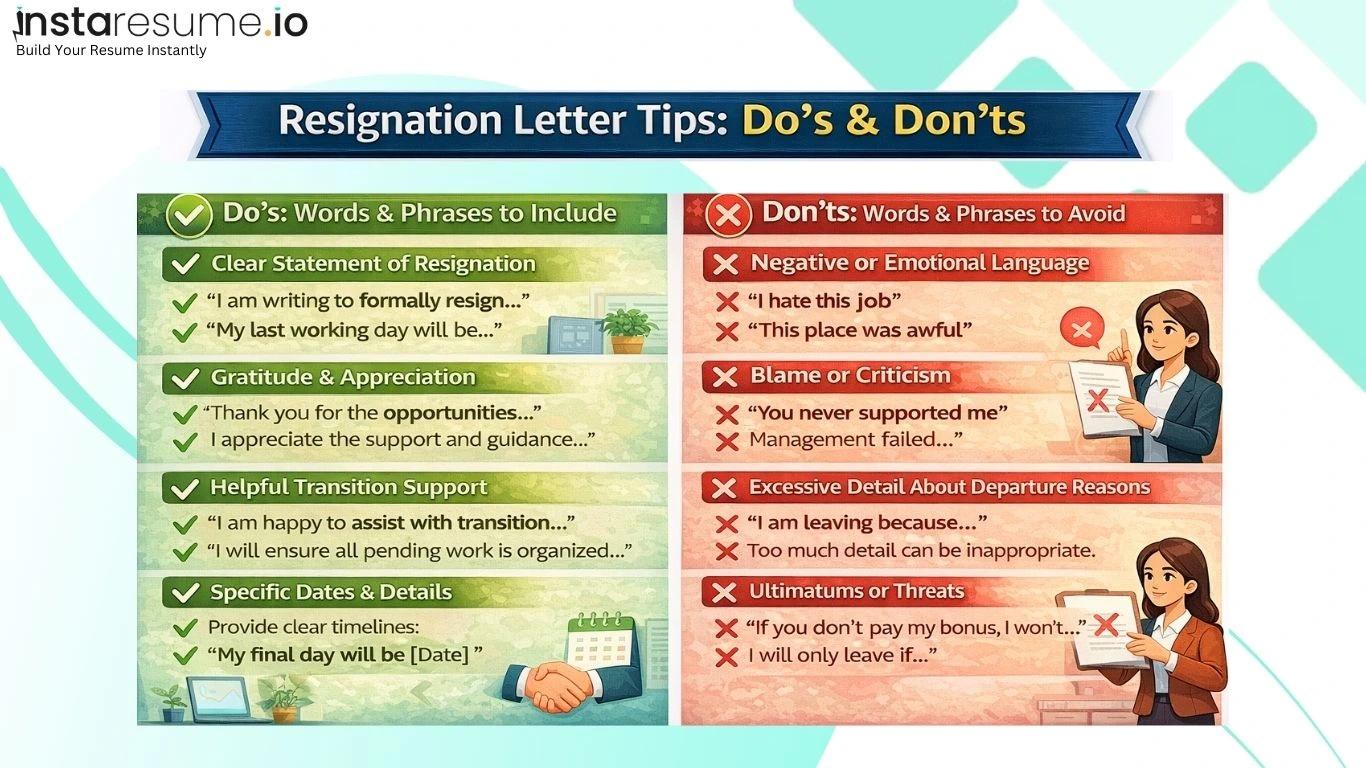
An infographic titled "Resignation Letter Tips: Do's & Don'ts" from instaresume.io, designed to guide professionals on how to write a graceful exit letter. The image is split into two columns: a green "Do's" section on the left and a red "Don'ts" section on the right.
Perfect resignation letter templates for different industries
1. Corporate / Office Job Resignation Letter
Subject: Resignation – [Your Full Name]
Dear [Manager’s Name],
Please accept this letter as formal notice of my resignation from my position as [Your Job Title] at [Company Name]. My last working day will be [Date], in accordance with my notice period.
I sincerely appreciate the opportunities for growth and learning that I have received during my time here. Working with the team has been a valuable experience.
I will do my best to ensure a smooth transition and complete all my responsibilities before my departure.
Thank you for your guidance and support.
Sincerely,
[Your Name]
2. IT / Tech Industry Resignation Letter
Subject: Resignation Notice – [Your Name]
Dear [Manager’s Name],
I am writing to formally resign from my position as [Your Job Title] at [Company Name]. My final working day will be [Date].
I am grateful for the professional development, technical exposure, and collaborative environment that I have experienced during my tenure here.
I will assist in knowledge transfer and handover of projects to ensure continuity during the transition period.
Thank you for the opportunity to be part of this organization.
Best regards,
[Your Name]
3. Healthcare Industry Resignation Letter
Subject: Resignation Letter – [Your Name]
Dear [Supervisor’s Name],
Please accept this letter as formal notice of my resignation from my role as [Your Position] at [Hospital/Clinic Name]. My last working day will be [Date].
I appreciate the chance to serve patients and work with such a dedicated healthcare team. The experience has been both meaningful and professionally rewarding.
I will ensure a smooth transition of patient responsibilities during my remaining time.
Thank you for your support.
Sincerely,
[Your Name]
4. Education Sector Resignation Letter
Subject: Resignation from [Your Position]
Dear [Principal/Administrator’s Name],
I am writing to formally resign from my position as [Your Designation] at [School/College Name]. My last working day will be [Date].
I am thankful for the opportunity to contribute to the academic growth of students and be part of such a respected institution.
I will complete all academic and administrative responsibilities before my departure.
Thank you for your guidance and cooperation.
Yours sincerely,
[Your Name]
Writing your resignation letter is the final step of your past role now it's time to focus on your future. Whether you’re eyeing a promotion or a total career pivot, your resume needs to be ready for the competition. Don’t just send a generic document; tailor your resume to your dream job in minutes or use our tools to make your resume stand out from the crowd today.
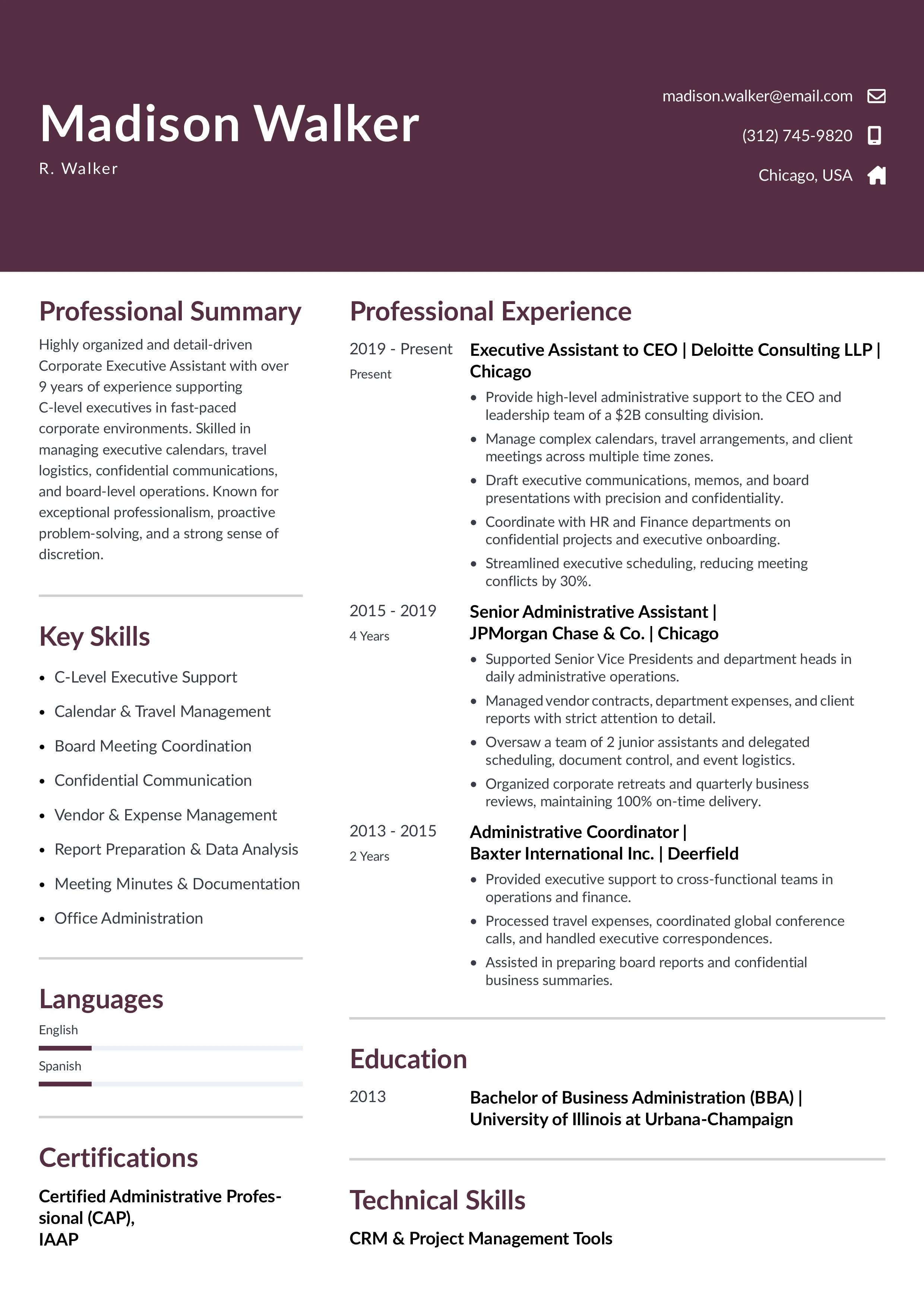
If you want you can edit this resume for Corporate executive assistant using minimalist resume templates.
Corporate executive assistant resume example
Frequently Asked Questions (FAQs)
1. What are the most common resignation letter mistakes?
The most common resignation letter mistakes include using emotional or angry language, complaining about your boss or company, giving too much personal information, forgetting to mention your last working day, and not thanking your employer. These mistakes can make your resignation letter look unprofessional and may harm your future career opportunities.
2. What should you not write in a resignation letter?
You should not write negative comments about your employer, coworkers, or workplace. Avoid sharing personal problems, frustrations, or reasons for leaving that sound emotional or critical. Knowing what not to write in a resignation letter helps keep it professional and respectful.
3. Can a bad resignation letter affect my future job?
Yes. A bad resignation letter can affect your professional reputation because companies keep resignation letters in their employee records. During background checks or reference verification, HR may review how you left your previous job.
4. How long should a resignation letter be?
A resignation letter should be short and clear, usually 3 to 4 short paragraphs. It should include your resignation statement, last working day, a brief thank-you, and a closing line. Long and detailed letters often lead to resignation letter errors.
5. Is it okay to complain in a resignation letter?
No. Complaining about your boss, salary, workload, or coworkers turns your letter into an unprofessional resignation letter. Always keep your tone polite and neutral, even if you had a negative experience.
6. Should I give a reason for resigning?
Giving a reason is optional. If you do, keep it simple and professional, such as “personal reasons” or “career growth.” Avoid detailed explanations that could be used against you later.
7. Do I need to mention my last working day?
Yes. Mentioning your last working day is very important. Not including it is one of the most common resignation letter mistakes and can create confusion about your notice period.