
Top 20 Most Common Interview Questions and Answers

Trust Score: 4.8
387 reviews
Table of Contents
“Success is not final; failure is not fatal; It is the courage to continue that counts.” — Winston Churchill
Welcome to our blog post on the Top 10 Interview Questions! In today’s highly competitive job market, being prepared for interviews is more important than ever. Whether you’re starting your career journey or looking to the next level of your career, mastering common interview questions can significantly increase your chances of success.
In this post, we’ll explore the top 10 interview questions that candidates mostly encounter in today’s job interviews. Understanding and effectively answering these questions can make all the difference in showcasing your skills and landing your dream job.
So, let’s dive in and discover how to confidently tackle these questions!
Create your resume now with instaresume.io
Want to make the process faster? Use an AI-powered resume builder that helps you create a modern, ATS-friendly resume in minutes complete with professionally written content suggestions and customizable templates.
Edit and download this example of a python data analyst resume created using the Instaresume's Sun · Simple resume template (Free)
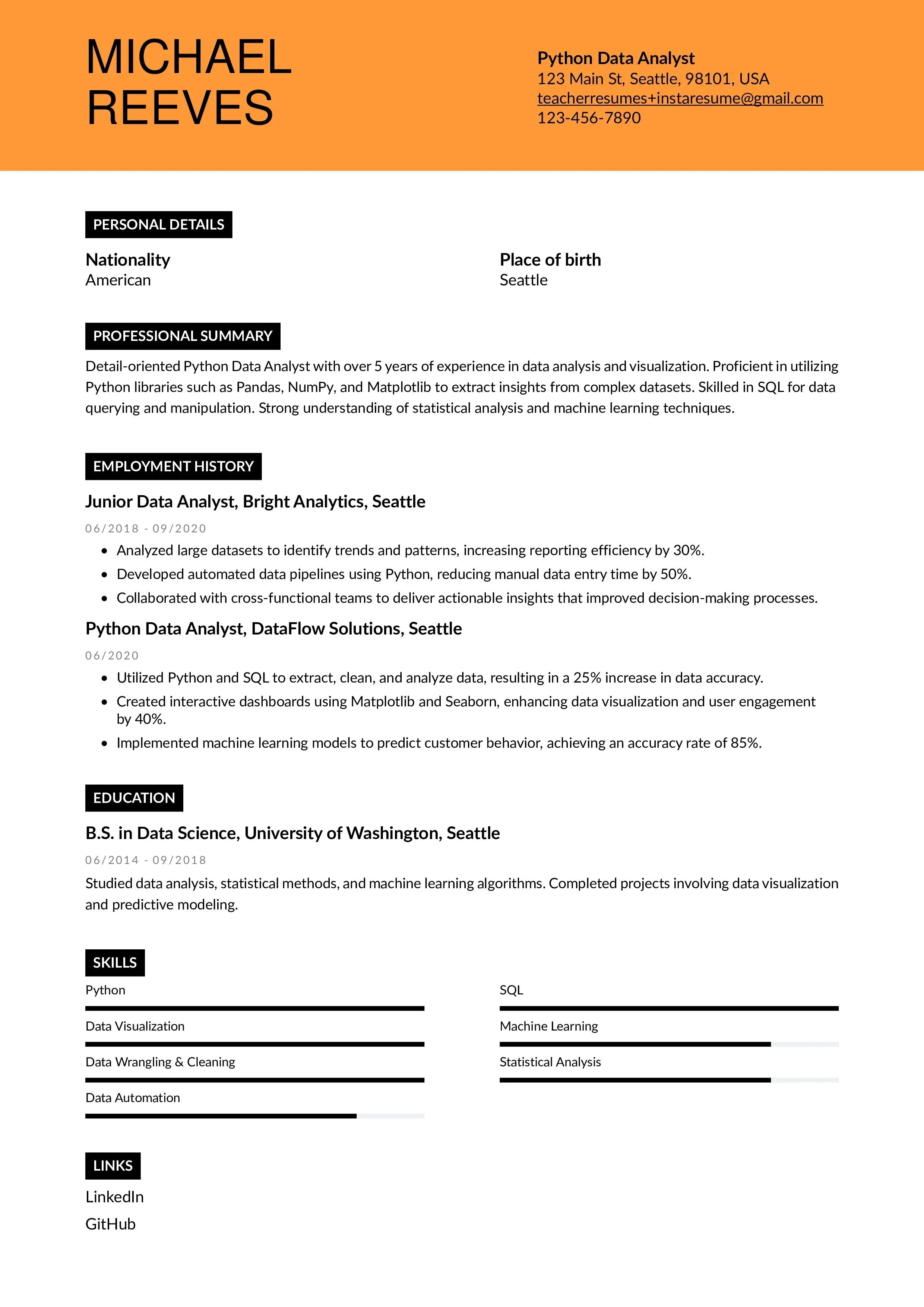
Sample resume made with our AI Resume builder—See more resume examples here.
Tell me about yourself? Interview question
The best answer to is to describe yourself briefly. Now, that doesn’t mean that the recruiter is interested in your family history or the name of your dog. No, this is strictly prohibited.
If you are a fresher, while answering this question, you need to start with a quick introduction [where you were born and brought up], then talk about your educational background, and your experience in any internship, and discuss your key value skills related to the job description.
If you are an experienced professional, you need to tell them where you were born and brought up. Educational details are optional. You need to focus extensively on your experience and skills.
Sample answer: “My name is [your name] and I was born and brought up in [city]. Throughout my career, I’ve had the opportunity to [briefly mention key experiences or accomplishments].
I’m particularly passionate about [mention specific area of interest or expertise], and I thrive in environments where I can [mention key strengths or attributes, such as problem-solving or collaboration].
Outside of work, I enjoy [mention hobbies or interests that showcase your personality]. I’m excited about the opportunity to bring my skills and experiences to [company name] and contribute to [mention what excites you about the role or company].”
If you want to master this question and read more sample answers for freshers and sample answers for experienced, you can read more at How to answer tell me about yourself?
What interests you about the position offered? Interview question.
This interview question whether a fresher or an experienced professional offers you a chance to align your interests with the role and company. Now while preparing this question you need to do your homework. You need to carefully think about what interests you about this position. Then further you need to prepare your answer by:
 Reading about the company’s values and missions.
- The opportunities company will provide to enhance you skillset.
Sample Answer 1: “What interests me most about this position is the opportunity to [mention specific aspect of the job, such as work on cutting-edge projects, collaborate with a talented team, or contribute to a meaningful cause]. I am excited about the company’s [mention specific company value, mission, or innovative approach], and I believe my skills in [mention relevant skills or experiences] make me well-suited to contribute to [company name]’s success.”
Sample Answer 2: “The aspect of this position that interests me the most is the chance to [mention specific responsibility or task, such as lead projects, drive innovation, or solve complex problems]. I am drawn to [company name]’s commitment to [mention specific aspect of the company culture or industry leadership], and I am eager to bring my expertise in [mention relevant skills or experiences] to help achieve [company name]’s goals and objectives.”
To truly master this question and read more sample answer for freshers and sample answer for experienced, delve into further resources on how to effectively respond to “What interests you about this position?”
Where do you see yourself in 10 years? Interview question
While preparing for this question you need to understand why recruiters ask this question :
- Do your aspirations for long-term career growth align with the company’s objectives? In essence, recruiters seek to discern whether you envision a lasting commitment to contributing to their team.
- Can you formulate goals that drive your career forward? Recruiters value individuals who set and attain ambitious objectives, as they have the potential to significantly enhance the company’s growth trajectory.
Sample Answer : In 10 years, I imagine myself as a very skilled [mention desired role or position] in [mention relevant industry or field]. I’ll use what I’ve learned to [mention a specific goal or contribution you’d like to achieve]. I also want to get really good at [mention a relevant area of professional development or personal growth]. I’ll be working at [company name], helping it do well and grow while always learning and getting better.
To become skilled at addressing this question and read more sample answer for freshers and sample answer for experienced, explore additional insights on how to effectively respond to “Where Do You See Yourself in 5 Years?”
Why should we hire you? Interview question
When answering the “Why should we hire you?” interview question, it’s important to highlight your unique skills, experiences, and qualities that make you the best fit for the role.
If you are a fresher , you need to focus on your key skill sets and achievements. You shouldn’t only focus on hard skills but soft skills too.
For example,
If you are an experienced professional you need to emphasis on your key skill sets, experiences and achievements. You should include both hard skills but soft skills .
For example,
Sample Answer : I bring a special mix of skills that fit this job perfectly. I’ve led a team before and we won first place! That taught me how to be a great leader. I’m really good at solving problems, so I can handle anything that comes our way. I’m also super motivated and ready to work hard. I know I can do a fantastic job here and help the team succeed.
To become perfect at answering this question and read more sample answer for freshers and sample answer for experienced, delve into additional resources on effectively responding to “How to answer Why should we Hire you?”
What is your greatest strength? Interview question
When responding to the “What is your greatest strength?” whether you are a fresh graduate or with limited experience, it’s an opportunity to showcase your abilities and knowledge.
Your response to this question helps interviewer evaluate several factors, including:
- Can you effectively apply skills and knowledge gained from academic, project, or volunteer experiences to meet the job requirements
- Problem-Solving Abilities : Have you encountered challenges and creatively overcome them?
- Leadership skills : Have you taken the initiative to lead a project or exceeded expectations in your responsibilities?
- Adaptability : Have you demonstrated the ability to learn new skills or adapt to changing situations?
- Have your actions led to positive outcomes for a project, team, or organization?
Sample Answer : One of my biggest strengths was [mention specific strength and how it helped you]. When I was working on [briefly describe what you were doing], I faced [mention problems or challenges]. But I didn’t give up! I used my smarts and hard work to solve the problems and succeed. I learned important things like teamwork and not giving up. It felt really good to see how my work helped [mention what happened because of what you did]. This shows that I’m really good at [mention a skill you have] and that I always try my best to do things well.
If you want to skill up this question and read more sample answer for freshers and sample answer for experienced, you can read more at What is your greatest strength?
What are your strengths and weaknesses? Interview question
Strengths
When addressing the “What are your strengths and weaknesses?” interview question, whether you are a fresher or experienced professional you should try to think and include all the positive qualities you possess. Here are some of the strengths to consider:
- Leadership abilities
- Strong communication skills
- Problem-solving skills
- Teamwork and collaboration
- Adaptability and flexibility
- Time management skills
- Creativity and innovation
- Analytical skills
- Attention to detail
- Ability to work under pressure
- Positive attitude
- Self-motivation
- Customer service skills
- Technical skills (e.g., proficiency in specific software or programming languages)
- Organizational skills
- Emotional intelligence
- Strategic thinking
- Conflict resolution skills
- Ability to learn quickly
Sample Answer : I’m really good at working with others as a team. In my last job, I led a project where we worked with different people and did a lot of research. It was sometimes stressful, but I learned how to encourage everyone and keep things going smoothly. Our client used our ideas to make a product that was good for the environment and didn’t cost too much.
To master the answer to this question and read more examples, dig in deeper into strategies for effectively responding to “How to answer What are your greatest strengths?”
Weaknesses
What comes to your mind when you think about weaknesses? For this question you first need to understand what actually recruiters are referring to when they talk about weaknesses.
Recruiters just want to know how self-aware you are and how will do you deal with your weaknesses. Not accepting your weaknesses is a big red flag for recruiters. Here are some weaknesses that you can consider: -
- Procrastination
- Difficulty delegating tasks
- Impatience
- Shyness
- Being overly critical of yourself
- Competitive
- Emotional
- Trouble with time management
- Being too detail-oriented
- Struggling with public speaking
- Tendency to avoid confrontation
- Insecure
- Disorganized
Sample Answer : I like things to be just right, so sometimes I find it hard to let others help me with my work. This means I end up doing too much by myself. But as a manager, I’ve learned to see the good things my teammates are good at and give them tasks that match. It was tough at first, but when I tell them what I need and trust them to do it, they do a great job. This helps me handle projects better and get things done faster.
To become proficient in answering this question and read more sample answer for freshers and sample answer for experienced, delve deeper into strategies for effectively responding to What are your Strengths and Weaknesses?
What are your salary expectations? Interview question
Discussing salary expectations during an interview can be delicate, but it’s crucial to approach it tactfully. Getting ready for the salary expectation question includes looking into industry standards and how the company usually pays its employees. This helps you figure out what a fair and reasonable salary might be.
You can figure out the fair and reasonable salary compensation by :
Online Resources
Explore websites such as Glassdoor, Salary.com, naukri.com and Payscale to gain insights into the starting or minimum salary for your job title and skill set. These platforms provide comprehensive salary data based on factors like experience, location, and job title. Upwork offers an hourly rate guide for various in-demand jobs.
Industry Insights
Engage with colleagues and professionals in your field to learn about their salary history, current earnings, desired salary, and negotiation strategies. Leveraging their experiences can offer valuable context, career advice, and a more accurate understanding of salary expectations.
Industry-specific salary surveys
Refer to industry-specific salary surveys for detailed information on salary ranges and trends. Resources such as government labor departments or industry-specific associations also offer salary data for different sectors and geographic areas, helping you assess an appropriate salary based on your skills and experience.
Job listings
Analyze job postings within your industry to identify average salary ranges or starting salaries offered by various companies. Platforms like LinkedIn, Indeed host active job listings, allowing you to determine salary expectations for your desired role across different organizations.
Consider Cost of Living
Factor in the cost of living in the job location when researching salaries. A higher salary in an area with a higher cost of living may not necessarily translate to a better standard of living compared to a lower salary in a region with lower expenses.
Here’s a response that strikes a balance between expressing your value and keeping the conversation open:
Sample answer 1 : I looked into the industry and thought about my experience and what this job involves. I think a fair salary would be about [mention salary]. But I’m willing to talk more about it as we go through the hiring process.
Sample answer 2: Considering the job requirements and my experience in the field, I believe a salary [mention salary] of would be fair. However, I understand that compensation goes beyond just the paycheck. I’m eager to discuss additional aspects such as benefits and opportunities for advancement within the company.
If you want to master this question, you can read more at What are your salary expectations?
How do you handle stress at work? Interview question
Pressure is a natural aspect of both life and the workplace, often arising from deadlines, limited budgets, and challenging tasks.
When discussing how you handle pressure be it a fresher or a experienced professional , it’s essential to be honest about your experiences and reactions, as everyone responds differently.
You should focus on highlighting your strengths and abilities, such as staying organized or effectively prioritizing tasks. You can provide specific examples using the STAR (Situation, Task, Action, and Result)method to demonstrate your experience dealing with pressure in the workplace.
While discussing past challenges, you must maintain a positive outlook by emphasizing on what you’ve learned and how you’ve grown.
Sample answer 1 :Previously as a student, I felt pressure to finish tasks on time and get good grades. I learned to handle this by working hard and staying organized. I also took breaks when I needed them and asked for help when I was stuck.
Sample answer 2:In my previous role as a manager, I led a team of 10 people where we frequently faced tight deadlines. To cope with the pressure, I learned to stay calm and focused. I found that communicating effectively with my team was key, as it helped us stay on track and support each other. Additionally, I made sure to delegate tasks fairly and offer assistance to team members when needed. This approach helped us successfully meet our deadlines and achieve our goals.
This response highlights proactive approaches to stress management, including organization, communication, and self-care, which are valued traits in any work environment.
If you want to master this question and read more sample answer for freshers and sample answer for experienced, you can read more at How to handle stress at work ?
Why do you want to work in this company? Interview question
Recruiters pose the question, “Why do you want to join our company?” to gain a deeper understanding of your motivations, aspirations, and compatibility with the organization’s values and goals.
Whether you are a fresher or an experienced professional they seek insights into your specific interest in the company and how well you align with its culture and mission.
Sample answer : Before the interview, I looked up your company to learn about its goals, what it sells, and how it works. I really liked how you try to make new things that help people. Your focus on remaining at the forefront of technology resonates with my own enthusiasm for continual learning and advancement.
Do you have any questions for us? Interview question
Asking thoughtful questions during an interview demonstrates your interest in the role and company while also providing an opportunity for you to gather important information. Here are a few questions you might consider asking:
- Could you describe the company culture and values, and how they influence day-to-day operations?
- What are the key priorities for this role in the first six months, and how will success be measured?
- Can you tell me about opportunities for professional development and growth within the company?
- What do you enjoy most about working for this company?
- How does the team collaborate and communicate on projects?”
- What are the biggest challenges facing the team/department/company right now?
- Can you walk me through the typical career path for someone in this role?
- How does this role contribute to the overall goals and mission of the company?
- What is the next step in the interview process, and what is the timeline for making a decision?
You can choose questions that align with your interests and priorities and use them to gain a deeper understanding of the role and company culture.
Why do you want to work at this company? Interview question
When responding to this question, whether you are a fresh graduate or an experienced professional, it’s an opportunity to demonstrate your research, genuine interest, and alignment with the company’s values and goals.
Your response helps the interviewer evaluate:
- Company Awareness: Do you understand the company’s mission, products, and market position?
- Cultural Fit: Do your values align with the organization’s work culture?
- Motivation Level: Are you genuinely interested or just applying randomly?
- Long-Term Intent: Are you likely to stay and grow with the company?
- Contribution Mindset: Can you add value to the company’s goals?
Sample Answer 2
“I’m particularly interested in your company because of its leadership in the industry and commitment to innovation. I’ve followed your recent initiatives in [specific area], and they align closely with my experience in [your field]. I’m looking for an opportunity where I can not only apply my skills but also grow in a forward-thinking environment. I believe I can contribute by bringing my experience in [specific skill/achievement] to help achieve your business objectives.”
Sample Answer 1
“I want to work at this company because of its strong reputation for innovation and growth. During my research, I was particularly impressed by your recent projects and how you focus on delivering customer-centric solutions. As a fresher, I’m looking for an environment where I can learn, grow, and contribute meaningfully. I believe my skills in [your skill] combined with your company’s dynamic culture would allow me to develop professionally while adding value to your team.”
Why do you want this job? Interview question
When answering this question, whether you are a fresher or an experienced professional, it’s your opportunity to clearly demonstrate how your skills, interests, and long-term career goals align with the role.
This is not just about saying you want the job it’s about showing that you understand the role, see value in it, and are genuinely motivated to contribute.
Your response helps the interviewer evaluate:
- Role Understanding: Do you have a clear understanding of the job responsibilities and expectations?
- Skill Alignment: How well do your skills and experiences match the requirements of the role?
- Career Direction: Does this position fit into your long-term career plans and growth path?
- Enthusiasm: Are you genuinely interested and motivated, or just applying generally?
- Value Addition: Can you contribute effectively and add value from the beginning?
A strong answer should connect three key elements:
What the role requires → What you bring → Why it matters for your future
Sample Answer 1
“I want this job because it aligns perfectly with my academic background and my interest in [field]. I’ve developed skills in [mention skills] through my projects and internships, and I’m eager to apply them in a practical environment. This role offers the opportunity to work on real-world challenges, which is exactly what I’m looking for to start my career.”
Sample Answer 2
“This role strongly aligns with my professional experience and career goals. I have hands-on experience in [relevant skill], and I see this position as an opportunity to further enhance those skills while contributing to impactful projects. I’m particularly excited about the responsibilities mentioned in the job description, especially [specific task], where I believe I can add immediate value.”
What is your greatest professional achievement? Interview question
When responding to this question, it’s an opportunity to highlight a specific achievement that showcases your impact, skills, and ability to deliver results.
Your response helps the interviewer evaluate:
- Result Orientation: Did you achieve clear or measurable success?
- Problem-Solving Skills: How effectively did you overcome challenges?
- Initiative & Ownership: Did you take responsibility and drive the outcome?
- Skill Application: How well did you apply your relevant skills?
- Impact: Did your actions create value for your team or organization?
Sample Answer 1 (Fresher)
“My greatest achievement was leading a college project where we had to develop [project topic]. Initially, our team faced issues with coordination and deadlines. I took the initiative to organize tasks, set timelines, and ensure clear communication. As a result, we completed the project ahead of schedule and received top grades. This experience helped me develop leadership and time management skills.”
Sample Answer 2 (Experienced)
“In my previous role, I led a project to improve process efficiency. We identified bottlenecks that were delaying output. I proposed a new workflow system and collaborated with the team to implement it. As a result, we improved efficiency by 25% and reduced turnaround time significantly. This achievement stands out because it required both strategic thinking and teamwork.”
Tell me about a time you demonstrated leadership skills. Interview question
When responding to this question, whether you are a fresher or an experienced professional, it is an opportunity to showcase your ability to take initiative, influence others, and drive results even without a formal leadership title.
Interviewers are not just looking for people who hold leadership positions; they are looking for individuals who step up in critical situations, take ownership, and guide teams toward success.
Your response helps the interviewer evaluate several important aspects:
- Leadership Ability: Can you guide and influence a team effectively?
- Initiative: Do you take responsibility when situations demand it?
- Decision-Making: Can you make thoughtful decisions, especially under pressure?
- Team Collaboration: Are you able to coordinate, motivate, and support others?
- Outcome Focus: Did your leadership lead to measurable or meaningful results?
A strong answer should follow a clear structure:
Situation → Your Initiative → Actions Taken → Result → Key Learning
Sample Answer 1
“During my final year project, our team was struggling to meet deadlines. I took the initiative to divide tasks based on individual strengths and set weekly goals. I also ensured regular check-ins to track progress. As a result, we completed the project successfully and received positive feedback from our faculty.”
Sample Answer 2
“In my previous role, I led a cross-functional team during a critical project. There were communication gaps between departments, which caused delays. I initiated regular meetings and streamlined communication channels. This improved coordination, and we successfully delivered the project before the deadline.”
What’s a time you disagreed with a decision at work? Interview question
When responding to this question, whether you are a fresher or an experienced professional, it is essential to demonstrate professionalism, respect for hierarchy, and the ability to handle disagreements constructively.
Interviewers are not testing whether you disagree they are evaluating how you disagree. A strong answer should show that you can voice your opinion thoughtfully, support it with reasoning, and still collaborate effectively regardless of the outcome.
Your response helps the interviewer evaluate several important qualities:
- Conflict Management: How do you handle disagreements in a professional setting?
- Communication Skills: Can you express your viewpoint clearly and respectfully?
- Emotional Intelligence: Do you stay calm, composed, and solution-focused?
- Flexibility: Can you accept and support a final decision even if it’s not your preference?
- Problem-Solving Approach: Do you contribute constructively rather than just criticize?
A strong answer should follow this flow:
Situation → Disagreement → How You Communicated → Outcome → What You Learned
Sample Answer 1
“In my previous role, I disagreed with a decision regarding project deadlines, as I felt it was unrealistic. I respectfully shared my concerns with my manager and suggested an alternative timeline based on workload analysis. While the final decision remained unchanged, my feedback helped the team prepare better, and we managed to meet the deadline with proper planning.”
Sample Answer 2
“I once disagreed with a strategy proposed during a team meeting. Instead of opposing it directly, I presented my perspective with supporting data. After discussion, we combined ideas from both approaches, which led to better results. This experience taught me the importance of constructive communication.”
Tell me about a time you failed. Interview question
When responding to this question, whether you are a fresher or an experienced professional, it is an opportunity to demonstrate self-awareness, accountability, and your ability to turn setbacks into growth opportunities.
Interviewers are not looking for perfection they are evaluating how you handle failure, learn from it, and improve moving forward. A strong answer should not just describe the failure but emphasize the lesson learned and the actions taken afterward.
Your response helps the interviewer evaluate several critical factors:
- Honesty & Accountability: Are you willing to admit mistakes without blaming others?
- Learning Mindset: Do you reflect on failures and extract meaningful lessons?
- Problem-Solving After Failure: Did you take corrective actions to improve the situation?
- Resilience: How well do you recover from setbacks and continue performing?
- Growth & Improvement: Did the experience lead to measurable or noticeable improvement in your performance?
A well-structured answer should follow a simple flow:
Situation → Failure → Action Taken → Lesson Learned → Improvement
Sample Answer 2
“In my previous job, I made an error in a report due to a lack of cross-checking. I immediately informed my manager and corrected it. After that, I implemented a personal checklist system to avoid similar mistakes. Since then, my accuracy has significantly improved.”
Sample Answer 1
“During my academic project, I underestimated the time required and missed an important milestone. I took responsibility, reassessed the plan, and worked extra hours to complete the project. This experience taught me the importance of time management and planning.”
Why are you leaving your current job? Interview question
When responding to this question, it is important to maintain a positive, professional, and forward-looking tone. Avoid criticizing your current or previous employer, and instead focus on growth, learning, and alignment with your career goals.
This question is not just about your reason for leaving it’s about how you frame your career decisions and how maturely you handle transitions.
Your response helps the interviewer evaluate several key factors:
- Professionalism: Do you maintain respect and integrity when discussing past employers?
- Career Goals: Do you have a clear direction and purpose behind your move?
- Attitude Toward Previous Employer: Are you respectful and appreciative of past experiences?
- Stability: Are you someone who frequently switches jobs, or do you make thoughtful decisions?
- Motivation for Change: Are you driven by growth and opportunity rather than dissatisfaction alone?
A strong answer should reflect gratitude for past experiences, clarity about your goals, and enthusiasm for the new opportunity.
Sample Answer 2
“In my current role, I’ve developed a strong foundation in [mention area], and I’m grateful for the experience I’ve gained. At this stage of my career, I’m looking for an opportunity that allows me to contribute at a higher level while continuing to grow professionally. This role stood out to me because it aligns perfectly with my skills and future aspirations.”
Sample Answer 1
“I’ve had a very positive experience in my current role and have gained valuable skills in [mention skills]. However, I’m now looking for new challenges that will allow me to expand my capabilities and take on more impactful responsibilities. I feel this opportunity aligns closely with my long-term career goals and offers the kind of growth and learning environment I’m seeking.”
Can you explain your employment gap? Interview question
When answering this question, honesty, clarity, and confidence are essential. Employment gaps are not necessarily negative if you can demonstrate that the time was used productively or was necessary for valid reasons.
Instead of being defensive, use this as an opportunity to show self-improvement, resilience, and readiness to return to work.
Your response helps the interviewer evaluate:
- Transparency: Are you honest and clear about your situation?
- Productivity During the Gap: Did you utilize the time constructively?
- Skill Development: Did you learn or improve relevant skills?
- Commitment to Career: Are you still serious about your professional growth?
- Readiness to Return: Are you prepared and motivated to re-enter the workforce?
A strong answer should highlight learning, growth, or responsibility, and end with a confident statement about your readiness.
Sample Answer 2
“I had to take some time off due to personal reasons that required my full attention. However, during this period, I made sure to stay connected with my field by following industry developments and improving my knowledge in [mention area]. Now that everything is settled, I’m fully ready and motivated to return to work and contribute effectively.”
Sample Answer 1
“I took a planned break to focus on personal development and upskilling. During this time, I completed courses in [mention skills], worked on practical projects, and stayed updated with industry trends. This period helped me strengthen my skill set and gain more clarity about my career goals. I’m now fully prepared and excited to apply these skills in a professional environment.”
Can you explain why you changed career paths? Interview question
This question is an opportunity to demonstrate clarity, intention, and strategic thinking behind your career decisions. Employers want to understand whether your shift is well-planned and sustainable, not impulsive.
A strong answer should clearly connect your past experiences with your current direction, highlighting how your journey has prepared you for this new path.
Your response helps the interviewer evaluate:
- Career Clarity: Do you have a clear understanding of your goals?
- Decision-Making Ability: Was your transition thoughtful and well-planned?
- Transferable Skills: Can you apply your previous experience in the new field?
- Commitment: Are you serious about this new career path?
- Long-Term Vision: Do you see yourself growing in this field?
The key is to position your change not as a switch, but as a strategic evolution.
Sample Answer 2
“After gaining experience in my previous field, I began exploring areas that better matched my long-term interests and strengths. I identified [new field] as a better fit and started preparing myself by acquiring relevant skills and practical experience. This was a well-thought-out decision, and I’m confident that my combined experience and new skills will allow me to add value in this role.”
Sample Answer 1
“Over time, I realized that my interests and strengths were more aligned with [new field]. While working in my previous domain, I developed several transferable skills such as [mention skills], which are highly relevant here. I then took deliberate steps to transition by learning and gaining exposure in this field. This shift allows me to pursue a career that I’m genuinely passionate about and where I can contribute more effectively.”
FAQs:
1. What are the most common interview questions?
Some of the most common interview questions include “Tell me about yourself,” “Why do you want to work here?”, “What are your strengths and weaknesses?”, “Why should we hire you?”, and “Where do you see yourself in five years?” Employers ask these questions to evaluate your skills, experience, and cultural fit for the company.
2. How should I prepare for common interview questions?
To prepare effectively, research the company, review the job description, and practice answering common interview questions out loud. Focus on sharing specific examples from your past experience that demonstrate your skills and achievements. Practicing your responses can help you sound more confident and natural during the interview.
3. How do you answer “Tell me about yourself” in an interview?
The best way to answer this question is by giving a short professional summary that highlights your background, key skills, and career goals. Start with your current role or education, mention relevant achievements, and briefly explain why you are interested in the position you’re applying for.
4. What are behavioral interview questions?
Behavioral interview questions focus on how you handled situations in the past. Employers use them to predict how you might behave in future work scenarios. Examples include “Tell me about a time you solved a difficult problem” or “Describe a situation where you worked under pressure.”
5. What is the best way to answer difficult interview questions?
The best approach is to stay calm, think before answering, and respond honestly. Structure your answers clearly by explaining the situation, what actions you took, and the result you achieved. This approach helps interviewers understand your problem-solving and decision-making skills.
6. What should you avoid saying in a job interview?
Avoid speaking negatively about previous employers, giving vague answers, or exaggerating your achievements. It’s also important not to interrupt the interviewer or provide overly long responses. Clear, honest, and concise answers make a better impression.
7. How long should interview answers be?
Most interview answers should be between 30 seconds and 2 minutes. This allows you to explain your experience clearly without overwhelming the interviewer. Short, focused answers that include specific examples are usually the most effective.
8. Why do interviewers ask about strengths and weaknesses?
Interviewers ask this question to understand your self-awareness and willingness to improve. When discussing strengths, focus on skills relevant to the job. When discussing weaknesses, choose something you are actively working to improve and explain how you are addressing it.
9. How can I stand out when answering interview questions?
To stand out, give specific examples, highlight measurable achievements, and tailor your answers to the company’s needs. Showing enthusiasm for the role and demonstrating strong communication skills can also leave a lasting impression on the interviewer.
10. What is the best strategy to answer interview questions confidently?
Confidence comes from preparation. Research the company, practice common interview questions, and focus on your achievements. Speaking clearly, maintaining good posture, and listening carefully to the interviewer can also help you appear more confident during the interview.
Conclusion
- Understanding the purpose behind common interview questions is crucial for success.
- Tailoring your answers to showcase your skills and experiences helps leave a lasting impression.
- Authenticity, confidence, and conciseness are key elements of effective responses.
- Highlighting strengths while addressing weaknesses with a positive outlook is essential.
- Preparation and practice are vital for confidently navigating through interview questions and increasing your chances of landing the desired job.